The Ultimate Guide to Effective Termite Control Options
Termite Control Starts With the Right Inspection
See mud tubes, discarded wings, or wood that sounds hollow? Schedule a professional inspection before choosing a treatment. Subterranean termites often need soil treatments or bait stations. Drywood termites may need treatment inside the affected wood. In either case, fixing leaks and keeping wood away from soil can help lower the risk of future damage.
Termites can stay hidden while they damage a home. That makes early detection especially important for homeowners in the Raleigh-Durham Triangle.
I’m Mitch Taylor, President of Capital Pest Services, Inc. With more than 17 years in pest management, I help homeowners make informed choices about termite control, from inspection through long-term prevention.
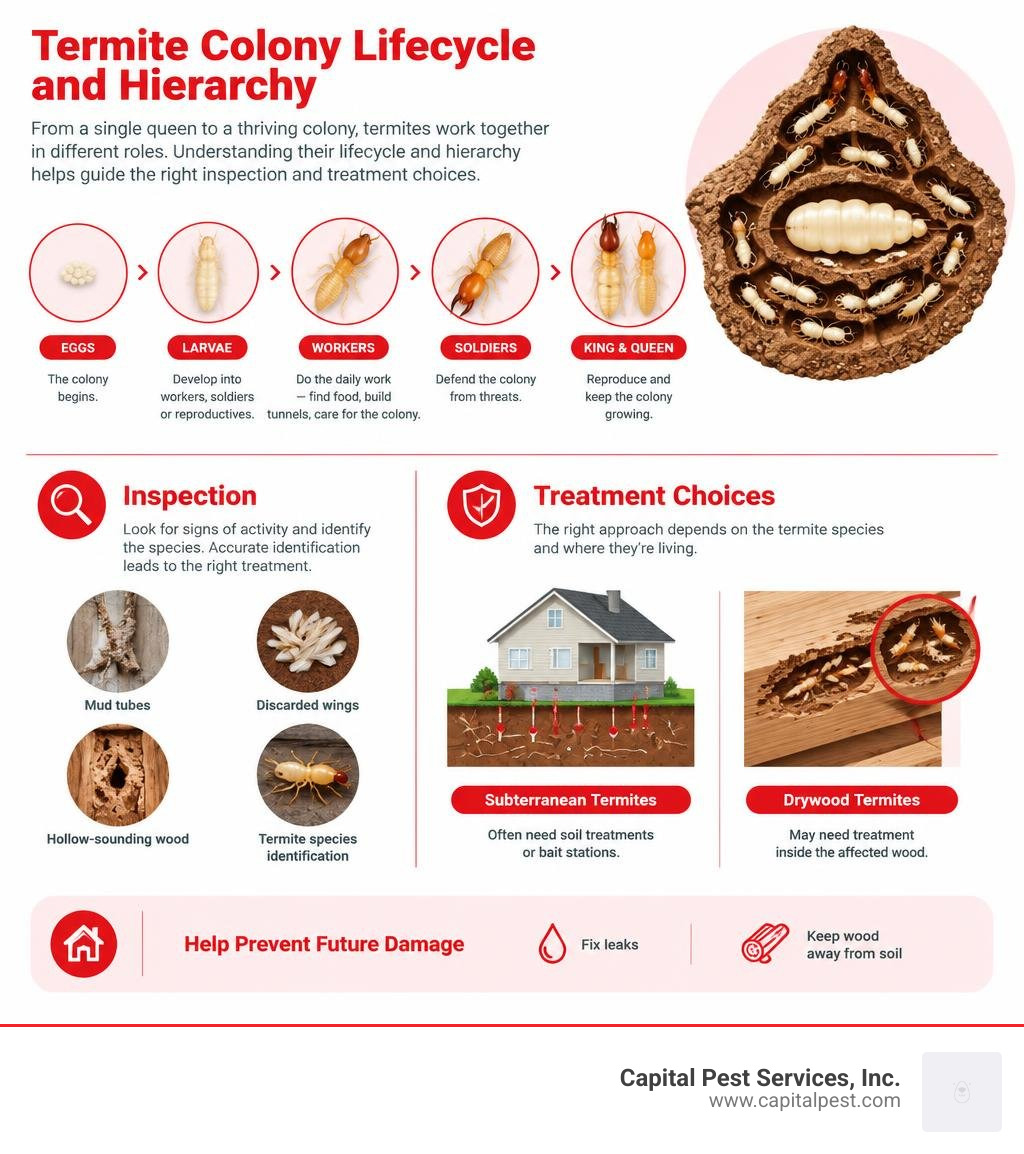
Every year, termites cause billions of dollars in structural damage across the United States, and property owners spend over two billion dollars just to treat them. In North Carolina and throughout the Southeast, termite activity is classified as very heavy. Because these insects feed on cellulose 24 hours a day without taking a holiday, even minor activity can spiral into structural repairs costing thousands of dollars if left unchecked. A proactive, integrated pest management strategy is essential to safeguarding your property.
Identifying Infestations: Termite Species, Signs, and Ant Distinctions
Effective eradication begins with accurate identification. Different species have unique nesting behaviors, moisture requirements, and wood-boring patterns. Misidentifying the insect can lead to applying the wrong treatment, wasting time, and allowing structural damage to worsen behind finished drywall or beneath subflooring.
Subterranean vs. Drywood Termites and Flying Ant Identification
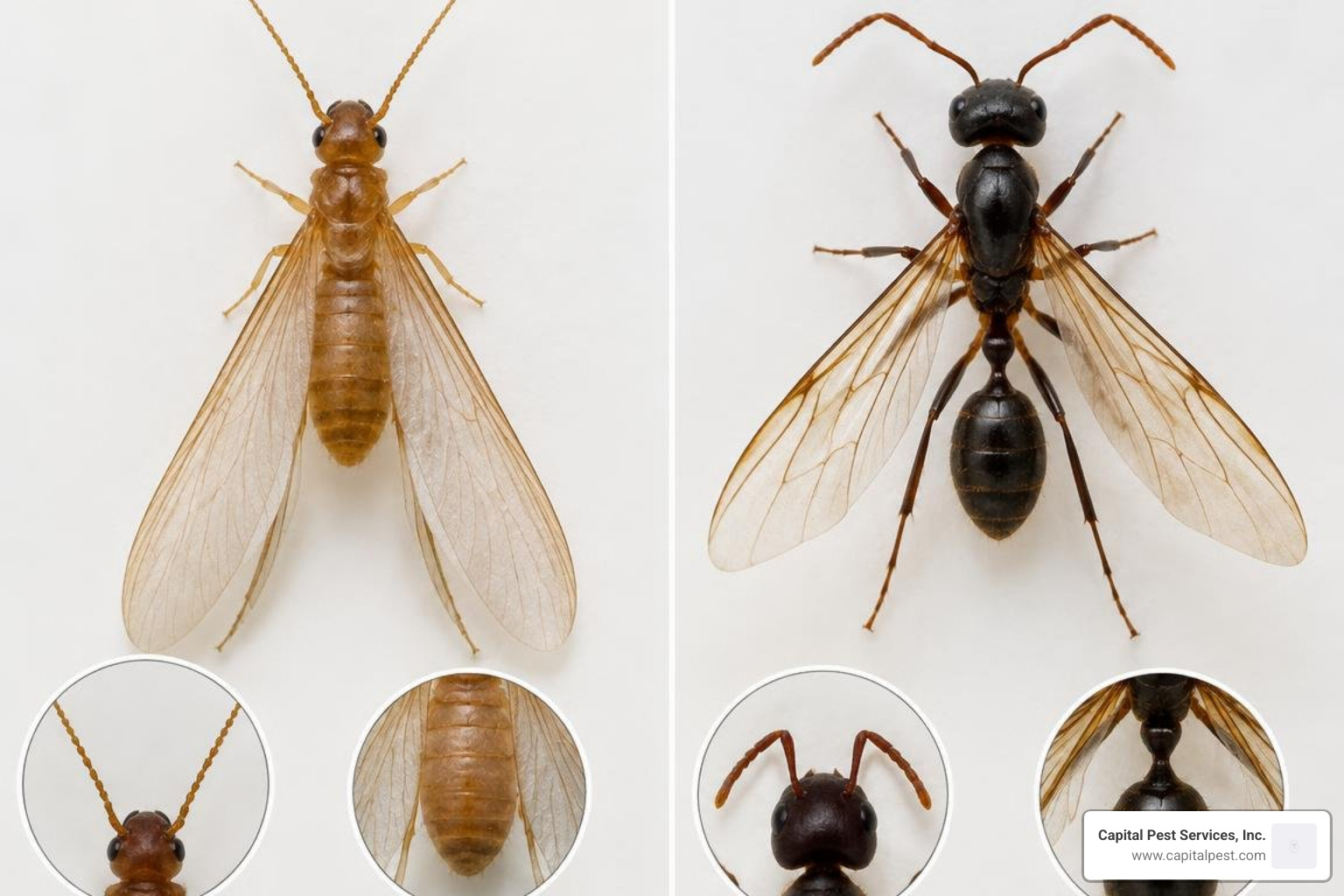
Homeowners often encounter termites for the first time during a spring swarm. When temperatures rise and humidity builds, reproductive termites (known as alates) emerge from established colonies in large numbers to mate and build new nests. However, swarming ants frequently fly during the same periods, causing widespread confusion.
To determine whether you are dealing with winged ants or termite swarmers, look closely at three key anatomical features:
- Waist Shape: Termites have a broad, uniform waist with a straight, continuous bodyline. Ants feature a distinctly pinched, narrow waist (petiole) between the thorax and abdomen.
- Antennae: Termite antennae are completely straight and resemble a string of tiny beads. Ant antennae are distinctly elbowed or bent at an angle.
- Wings: A termite swarmer has two pairs of wings that are completely equal in size, length, and shape, extending well past the tip of its abdomen. Winged ants have larger, longer forewings in the front and noticeably smaller hindwings behind them.
When dealing with wood-infesting ants rather than termites, our specialized professional ant control provides targeted solutions. For additional anatomical breakdowns and insect behavior profiles, consult Purdue University entomology research on wood-destroying insects.
Beyond distinguishing ants from termites, you must identify whether subterranean or drywood termites have invaded:
- Eastern Subterranean Termites (Reticulitermes flavipes): The most widespread and destructive species in the Raleigh-Durham area. They require direct contact with soil moisture to survive and construct intricate mud tubes across foundation walls to reach wooden structural members.
- Drywood Termites (Incisitermes and Cryptotermes species): These termites nest entirely inside sound, dry structural wood, framing, or furniture without needing soil contact. They extract moisture directly from the wood they consume and atmospheric humidity.
Recognizing Critical Signs of Wood and Structural Damage
Because termites feed from the inside out, extensive structural compromise can develop before any exterior surface shows visible distress. Professional inspectors look for several definitive warning signs during a comprehensive assessment:
- Mud Shelter Tubes: Subterranean termites construct pencil-thin tunnels made of soil, wood particles, and saliva along masonry foundations, crawlspace piers, joists, and drywall to maintain humidity and shield themselves from predatory ants.
- Frass (Fecal Pellets): Drywood termites push their waste out of microscopic “kick-out” holes in infested wood. These pellets are hard, elongated, six-sided, and resemble tiny piles of sand, sawdust, or ground pepper on window sills and flooring.
- Hollow-Sounding Timbers: Probing suspicious wood framing, baseboards, or sill plates with a flathead screwdriver will reveal hollow cavities or thin, papery surface veneers left intact by foraging workers.
- Blistered or Bubbling Paint and Drywall: Moisture brought into wall cavities by subterranean worker termites can cause interior drywall paper to buckle, paint to blister, or ceilings to sag, mimicking water leaks.
- Discarded Swarmer Wings: Piles of translucent, silvery wings left behind on window ledges, spiders’ webs, or patio slabs indicate a recent swarming event inside or adjacent to the foundation.
- Excess Crawlspace Moisture: Damp soil, standing water, poor perimeter grading, and unventilated crawlspaces create ideal conditions for subterranean termite colonies to thrive.
Modern Termite Control: Essential Treatment Strategies
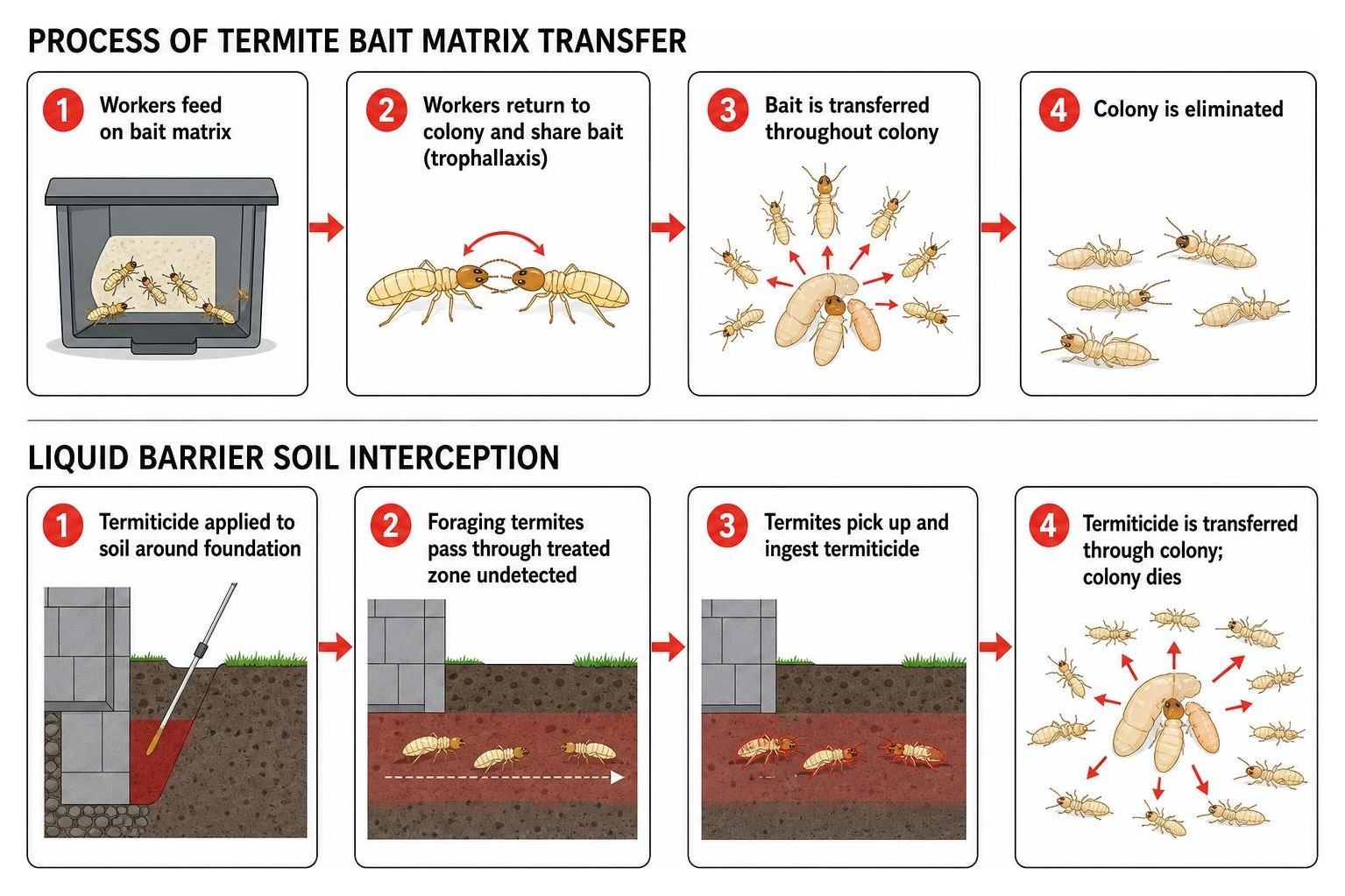
Modern structural defense has evolved from relying on harsh, broad-spectrum repellents to deploying precision chemistry and targeted perimeter defense systems. Complete colony eradication requires solutions that exploit natural social behaviors, such as mutual grooming and food sharing (trophallaxis).
Liquid Soil Barriers vs. Perimeter Bait Stations
For subterranean species, pest management professionals rely on two proven structural defense options: continuous liquid soil barriers and exterior perimeter bait stations. Both approaches provide dependable defense, but they function through completely different mechanisms.
- Liquid Soil Barriers: Technicians create a continuous treated zone by trenching and rodding non-repellent liquid termiticides (such as fipronil) into the soil around the exterior perimeter foundation, utility penetrations, and crawlspace support piers. When concrete slabs, driveways, or patios abut the foundation, technicians drill precise holes through the masonry to inject the liquid into the underlying soil. Because the chemical is undetectable, foraging termites pass through it freely, coat their cuticles, ingest the active ingredient, and transfer it throughout the central subterranean colony before succumbing.
- Perimeter Bait Stations: In-ground monitoring stations containing cellulose attractants are installed every 10 to 15 feet around the home’s exterior drip line. When termites find the station, the matrix is replaced with a slow-acting chitin synthesis inhibitor or metabolic disruptor. Foraging workers consume the bait and carry it back to share with the queen and developing larvae. Over several weeks, the active ingredient stops workers from molting, causing the entire colony to collapse.
| Treatment Feature | Liquid Soil Barrier Defense | Perimeter Bait Station System |
|---|---|---|
| Primary Mechanism | Continuous non-repellent chemical treated zone in perimeter soil | Targeted insect growth regulator bait matrix consumed and shared |
| Colony Impact | Direct mortality and horizontal transfer across active foragers | Complete subterranean colony elimination via disrupted molting |
| Structural Invasiveness | Requires trenching soil; may require drilling concrete patios/slabs | Non-invasive installation; placed in soil beds around drip line |
| Inspection Requirements | Long-lasting residual protection; annual structural inspection | Periodic station monitoring and bait replenishment |
| Site Suitability | Ideal for standard foundations with accessible perimeter soil | Ideal for homes near wells, cisterns, or inaccessible sub-slabs |
Choosing between these methods depends on your home’s construction style, structural accessibility, soil drainage, and proximity to sensitive private wells or waterways.
Advanced Localized Injections and No-Tent Termite Control
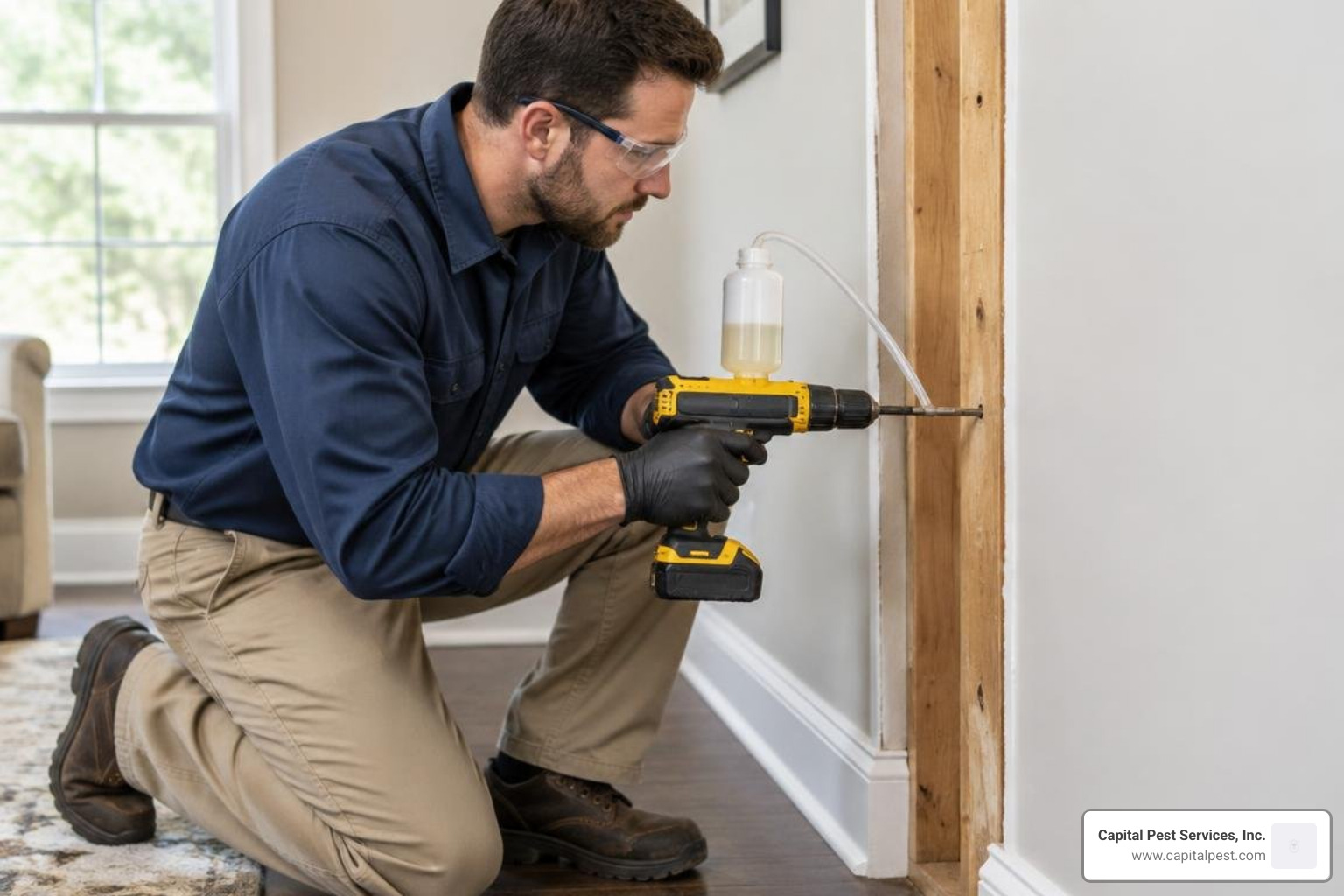
Treating drywood termites requires addressing isolated colonies residing above ground within wall studs, roof rafters, and door headers. While whole-structure fumigation (tenting) envelops the entire building in sulfuryl fluoride gas, modern homeowners increasingly favor localized, non-fumigation protocols whenever infestations are contained:
- Precision Gallery Injections: Technicians locate drywood galleries using acoustic sensors, thermal imaging, and wood probing. Small holes are drilled directly into infested timber galleries, followed by the injection of non-repellent liquid termiticides or expanding foam formulations. The foam expands through internal tunnels, coating every insect and leaving a residual barrier that prevents re-infestation.
- Borate Wood Treatments: Soluble disodium octaborate tetrahydrate (DOT) solutions are applied directly to unfinished timber framing, sill plates, and crawlspace joists. Borates penetrate deep into the wood fibers, acting as an internal metabolic stomach poison that provides long-term protection against drywood termites and wood-boring beetles.
- No-Tent Non-Repellent Approaches: By applying slow-acting, non-repellent formulations directly to structural hotspots, termites spread the active agent across the entire gallery via grooming and contact without requiring family members to vacate the property, strip food from pantries, or remove landscaping.
Breakthrough Research: How Chemical Attractants Improve Treatment Efficacy
Recent entomological research from the University of California, Riverside, led by urban entomologist Dr. Dong Hwan Choe, is helping reshape localized injection treatments for wood-destroying insects.
Historically, localized wood injections faced a significant obstacle: technicians had to drill numerous holes into finished walls to ensure termiticides directly reached isolated, branching galleries. If a pocket of termites was missed by just a few inches, the insects could survive and expand their network. Furthermore, termites are selective feeders that target specific wood species and preferred grain sections while avoiding others.
Dr. Choe’s research demonstrates that specific chemical communication compounds can actively draw termites toward treated zones:
- The Power of Pinene: Researchers discovered that adding pinene—a natural, forest-tree-derived hydrocarbon chemical attractant—to localized insecticide formulations significantly improves treatment performance.
- Directed Movement: In controlled laboratory trials, termites displayed a strong preference for wood sections treated with pinene combinations, moving toward the attractant rather than scattering away from the treated zone.
- Higher Mortality with Fewer Drill Holes: Combining chemical attractants with non-repellent insecticides produced higher mortality rates while requiring fewer localized injection sites. This breakthrough reduces drilling through finished drywall, decreases labor time, lowers application costs, and improves control of hidden drywood colonies.
This research highlights an industry shift away from broad chemical broadcast applications toward bio-rational, behavior-driven insect management.
Long-Term Prevention, Safety Standards, and Selecting a Provider
Effective wood-destroying insect management pairs professional treatment with targeted property maintenance. Removing the environmental conditions that attract termites significantly reduces the risk of structural re-infestation.
Structural Moisture Management and Pre-Construction Defense
Subterranean termites depend on consistent moisture to survive. Maintaining a dry foundation zone deters foraging workers from establishing mud tubes near structural framing:
- Maintain Soil-to-Wood Clearance: Ensure a minimum clearance of 6 inches between bare soil and any wooden structural element, including siding, deck ledger boards, and lattice work.
- Divert Foundation Water: Clean gutters regularly, extend downspout discharge pipes at least 5 to 10 feet away from foundation walls, and slope soil grading away from the home.
- Control Crawlspace Humidity: Install a sealed, high-mil vapor barrier across exposed crawlspace ground soil, verify proper foundation vent airflow, and use heavy-duty crawlspace dehumidifiers to keep wood moisture content below 15%.
- Eliminate Ground Wood Debris: Remove fallen tree limbs, old construction lumber, tree stumps, and landscape timbers near the foundation. Keep decorative wood mulch beds pulled back at least 12 to 18 inches from exterior masonry walls.
- Install Physical Barriers During Construction: Non-chemical pre-construction techniques, such as marine-grade stainless steel mesh (Termi-Mesh) or calibrated uniform basalt sand barriers, prevent termites from penetrating slab expansion joints and utility pipe conduits.
- Schedule Pre-Treatments: When building additions, pouring slabs, or constructing a new home, applying specialized pre-construction termite treatments directly to the soil and rough framing establishes an unbroken protective barrier before drywall is hung.
Integrating these preventative habits into an ongoing residential pest management routine ensures your structure remains well-protected year-round.
Hiring Licensed Professionals for Safe Termite Control
All termiticides used in modern residential pest management must undergo rigorous safety evaluations by the U.S. Environmental Protection Agency (EPA) before registration. The registration process requires more than 100 scientific and toxicological studies to evaluate:
- Environmental persistence and degradation pathways in various soil types.
- Potential leaching characteristics near groundwater, wells, and surface runoff.
- Mammalian safety, indoor air quality impacts, and structural re-entry intervals.
Because professional-grade termiticides require specialized application equipment, high-pressure injection pumps, and precise dosing calculations, they should only be applied by trained, state-certified technicians. Review EPA guidance on termite identification and regulation to learn more about how federal and state standards protect consumers.
When evaluating a pest management provider for your home or commercial facility, ask these essential qualifying questions:
- Are your technicians certified and licensed with the North Carolina Department of Agriculture and Consumer Services (NCDA&CS)?
- Do you perform a comprehensive, written wood-destroying insect inspection before presenting a treatment plan?
- What specific EPA-registered active ingredients do you use, and what are the required re-entry intervals for family members and pets?
- Does your proposal include an annual renewable warranty covering both retreatment and future structural damage repairs?
- Are bait stations regularly inspected and maintained under a continuous monitoring agreement?
Homeowners seeking long-term peace of mind often choose renewable termite protection plans that combine annual multi-point inspections with dedicated repair and retreatment warranties.
Frequently Asked Questions About Termite Infestations
How do I know whether I have drywood or subterranean termites?
The primary indicators are soil dependency, gallery structure, and waste evidence. Subterranean termites require soil moisture, build earthen mud shelter tubes over foundation footings, and leave galleries lined with mud and dark soil spotting. Drywood termites live completely inside dry wood without soil contact, carve clean, smooth internal galleries, and expel dry, six-sided, sand-like fecal pellets from small kick-out holes. Subterranean termites are far more common in North Carolina and the Southeast.
Are modern termiticide applications safe for families and pets?
Yes, when applied by licensed professionals in accordance with EPA product labeling. Modern non-repellent liquid termiticides bind tightly to soil organic matter once applied, preventing chemical drift and vapor release into indoor living areas. Exterior bait stations are securely locked in tamper-resistant, in-ground plastic housings inaccessible to children and pets. Technicians provide clear instructions regarding re-entry intervals (typically waiting until localized surface sprays are dry) to keep everyone safe.
Can a homeowner treat an active termite infestation with DIY products?
Over-the-counter sprays and contact retail insecticides are generally ineffective against active termite colonies. These products only kill the small percentage of foraging worker termites visible on the surface. Because consumer sprays act as repellents, they can cause the wider colony to seal off the treated section, scatter, and establish new feeding galleries in other structural areas. Eliminating an infestation requires non-repellent chemistries or insect growth regulators that foraging insects carry deep into the colony to reach the reproductive queen.
Conclusion
Termite activity represents an ongoing, year-round threat to homes throughout Raleigh, Durham, Cary, Chapel Hill, Wake Forest, Apex, Morrisville, Holly Springs, Garner, Fuquay-Varina, Clayton, Knightdale, Wendell, Zebulon, Rolesville, Youngsville, Franklinton, Oxford, Sanford, Pittsboro, and Spring Hope. Left unattended, these silent invaders can undermine structural framing, compromise subflooring, and cause thousands of dollars in hidden damage.
At Capital Pest Services, Inc., our locally owned, NPA-accredited team combines proven integrated pest management, eco-friendly liquid and baiting solutions, and a straightforward “one-call” approach to protect your property investment. Whether you are addressing an active infestation, planning a new construction build, or scheduling an annual inspection, our technicians provide comprehensive, multi-layered structural defense.
Contact our team today to schedule an inspection with our expert termite control services and secure long-term protection for your home.
Capital Pest is proud to be a family-owned and operated pest control company serving Raleigh, NC and its surrounding area (Chapel Hill, Wake Forest, Clayton, Pinehurst, Pittsboro, Fuquay-Varina, etc). Contact us for our pest control services today!