Sanitize and Secure Kitchen Cabinets After a Mouse Infestation
Understanding Why Rodents Target Kitchen Voids and Entry Routes
To eliminate mice in kitchen cabinets, remove all accessible food, sanitize contaminated surfaces with a disinfectant solution, set snap traps along cabinet edges and utility runs, and seal every gap larger than 1/4 inch with copper mesh and silicone caulk. This combination of sanitation, trapping, and exclusion stops current activity and prevents new rodents from entering.
Mice do not invade your kitchen out of sheer boldness; they are opportunistic foragers driven by basic biology. A house mouse requires only about 3 grams of food per day to survive. That means a single dropped cracker, a stray noodle beneath a lazy Susan, or a minor spill behind an appliance can sustain a rodent for multiple days. When you combine steady food access with the ambient warmth thrown off by refrigerator compressors, dishwashers, and oven insulation, your kitchen cabinetry transforms into prime real estate.
The architectural structure of modern cabinetry makes access surprisingly easy. When contractors install sinks, dishwashers, and gas ranges, they drill rough cutouts through the drywall and cabinet backing to run supply lines, drain lines, and electrical conduit. These holes are almost always cut significantly larger than the pipes themselves. To a rodent navigating the structural wall studs, these jagged openings serve as direct entry highways into your food storage zones. Learn more about how mice enter kitchen cabinetry through hidden voids to understand these structural blind spots.
Beyond utility penetrations, the empty void beneath your lower cabinets—the area behind the decorative toe-kick panel—creates a dark, low-traffic runway. Mice easily travel through exterior weep screeds, crawlspace subfloors, or wall cavities, dropping directly into this sub-cabinet chamber without ever stepping out onto your open kitchen floor.
Health Risks and Food Safety Dangers of Mice in Kitchen Cabinets
A rodent presence in your pantry is not merely an aesthetic annoyance; it is a serious health hazard. Because rodents constantly explore while foraging, they deposit microscopic droplets of urine, fecal pellets, and saliva across every surface they touch, including cookware, dishes, and pantry goods.
Mice are known vectors for several severe illnesses:
- Salmonellosis: A bacterial infection transmitted when rodents walk through contaminated areas and subsequently track bacteria across silverware, plates, and food containers.
- Leptospirosis: A bacterial disease spread through contact with soil, water, or surfaces contaminated with rodent urine.
- Hantavirus: A respiratory infection that can become severe. The primary risk occurs when dried urine and droppings are disturbed, creating airborne particles that family members can inhale.
Mice constantly gnaw to keep their open-rooted incisors trimmed. They chew through thin cardboard boxes, plastic bags, and wax paper packaging, contaminating the food inside long before a homeowner notices visible external damage.
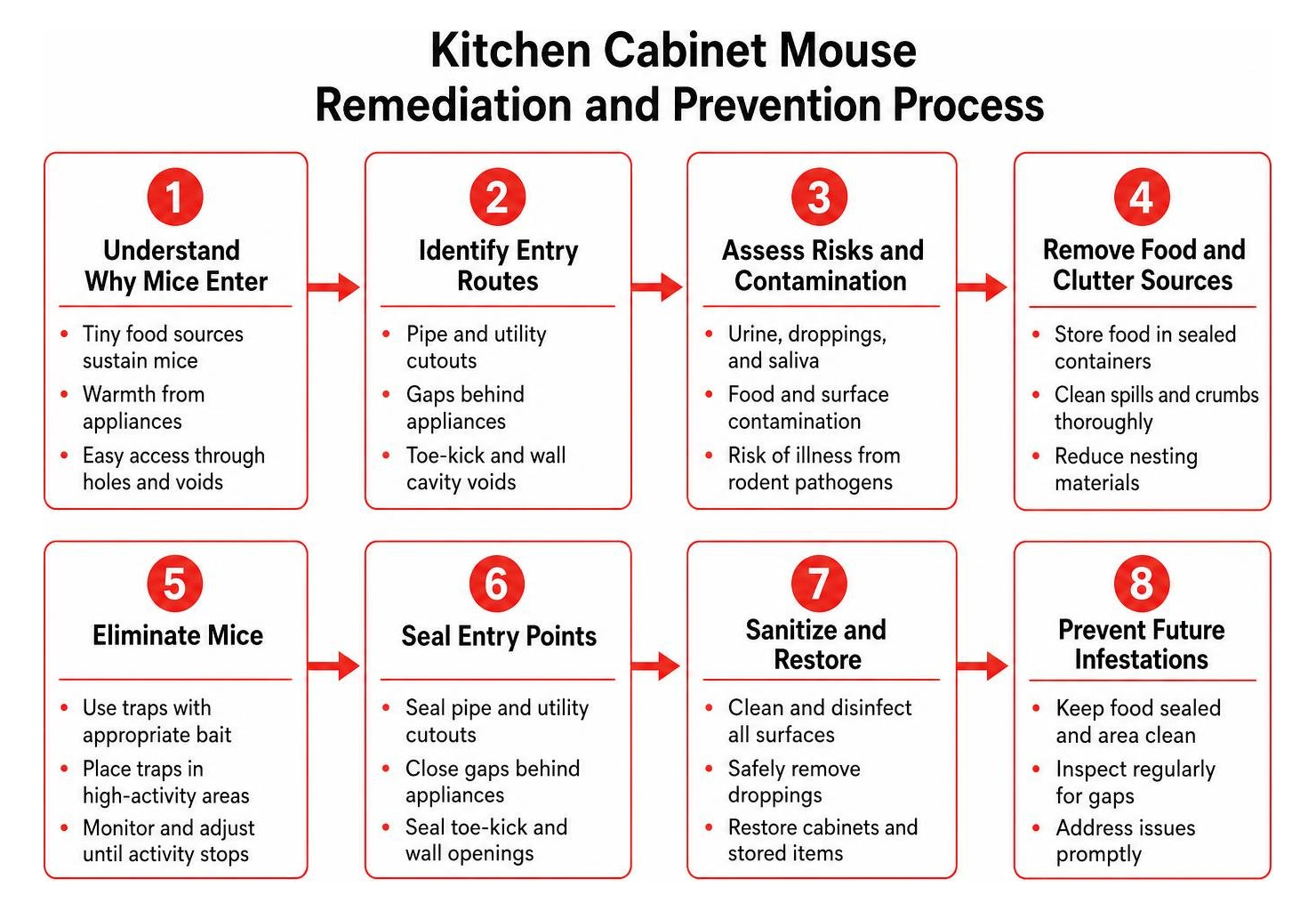
How to Identify and Eliminate Mice in Kitchen Cabinets
Getting rid of rodents inside cabinetry requires a methodical approach. Skipping straight to retail chemical baits or scattering a single trap beneath the sink rarely yields results. Effective eradication depends on using the right equipment, placing it correctly, and understanding rodent psychology.
| Trap Type | Bait Strategy | Placement Technique | Best Use Case |
|---|---|---|---|
| Classic Wooden/Plastic Snap Trap | Pea-sized dab of peanut butter or hazelnut spread | Perpendicular to back wall; trigger facing inward toward the wall edge | Inside lower cabinets, behind toe-kicks, and along wall runways |
| Enclosed Snap Trap | High-protein bait (peanut butter, bacon grease) | Along baseboard junctions, parallel to cabinet kickplates | Homes with curious pets or small children |
| Multi-Catch Live Trap | Seeds, grain mixtures, or nesting material (cotton balls) | Flush against flat vertical surfaces near appliance voids | Monitoring persistent runs without snap mechanisms |
Mice possess poor eyesight and navigate primarily through touch, relying on their sensitive whiskers (vibrissae) while following structural wall edges. Traps set in the middle of a shelf will likely be ignored. Place triggers facing the cabinet backboard or side panel so the rodent encounters the bait naturally along its normal path of travel. For severe infestations where rodents have established travel routes throughout wall cavities, our team provides targeted professional rodent control services to quickly stop the breeding cycle.
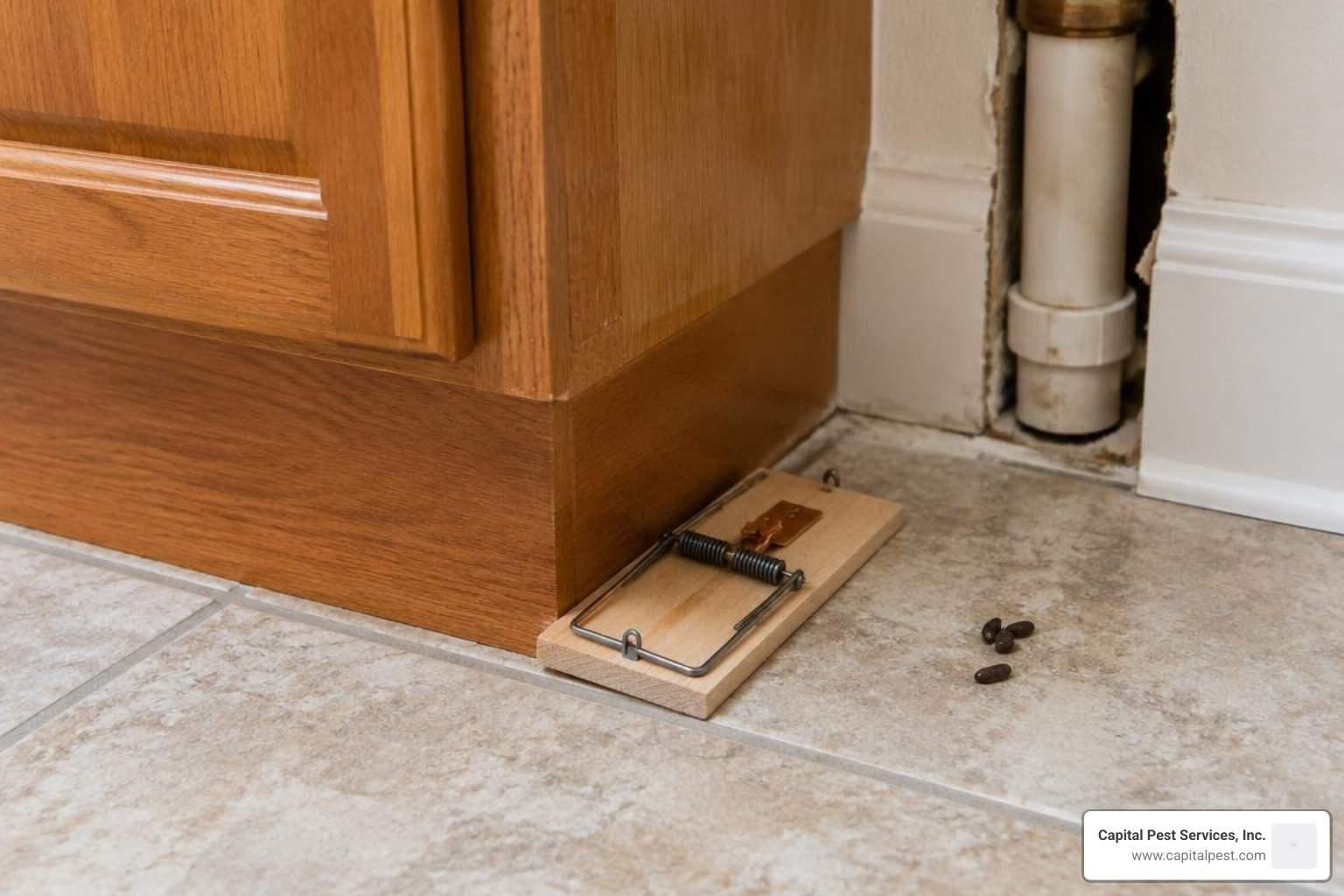
Warning Signs of Mice in Kitchen Cabinets
Catching an infestation early prevents localized activity from turning into a full-scale colony. Keep an eye out for these telltale indicators:
- Droppings: Smooth, dark pellets roughly the size of a grain of rice (3–6 mm) with pointed ends, commonly found along shelf corners, under silverware trays, and behind trash bins.
- Gnaw Marks: Small, parallel tooth grooves on wooden cabinet frames, plastic storage bins, or dry-goods containers.
- Grease Rub Marks: Mice secrete sebaceous oils from their fur. As they squeeze through narrow gaps, they leave dark, oily smudges around pipe collars and cabinet cutouts.
- Ammonia Odors: A persistent, stale, musky smell, particularly noticeable in closed cupboards or under the sink.
- Nesting Debris: Shredded paper towels, packaging materials, or fiberglass insulation bunched into small, hidden clusters. Learn whether mice nest behind base cabinetry to evaluate the structural hiding spots inside your home.
Critical Trapping Mistakes to Avoid
DIY rodent management often stalls due to a few common, easily preventable mistakes:
- Under-Deploying Traps: Setting two traps for an active population is rarely enough. Deploy 4 to 6 traps per infested cabinet bank to maximize catch rates within the first 48 hours.
- Over-Baiting: Piling on large amounts of bait allows a mouse to lick the edges cleanly without tripping the strike plate. Use a tiny, pea-sized smear pressed firmly into the bait cup.
- Using Indoor Rodenticides: Never place toxic anticoagulant baits inside kitchen cabinets. A poisoned mouse will often crawl deep into sub-cabinet voids or interior wall cavities to die, resulting in foul decomposition odors and secondary insect infestations.
- Leaving Food Readily Available: If rodents can access open flour sacks or loose cereal, they have little reason to investigate trap triggers.
Step-by-Step Sanitization: Cleaning Contaminated Cabinet Spaces
Cleaning up after rodent activity requires careful safety steps. Sweeping with a broom or using a household vacuum cleaner can disturb dried urine and feces, sending pathogens into the air you breathe.
Follow this systematic sanitation protocol:
- Gear Up Appropriately: Put on non-porous rubber or nitrile gloves and an N95 respirator mask before opening contaminated cabinet doors.
- Prepare a Disinfectant Solution: Mix 1.5 cups of household bleach per gallon of warm water (a standard 1:10 dilution ratio), or use an EPA-registered hospital-grade disinfectant spray.
- Soak, Do Not Sweep: Spray all droppings, nesting materials, and nearby surfaces thoroughly with the disinfectant until fully saturated. Allow the solution to sit undisturbed for 5 to 10 minutes to neutralize active pathogens.
- Wipe Clean with Paper Towels: Pick up saturated waste using disposable paper towels. Place the used towels directly into a plastic garbage bag, tie the bag tightly, and discard it in an outdoor bin.
- Wash and Decontaminate Surfaces: Scrub the entire interior of the cabinet—including shelf undersides, corners, and hinge plates—with the disinfectant solution. Rinse with clean water and allow shelves to air dry completely.
- Discard Compromised Food: Safely throw away any non-airtight dry goods, cardboard packaging, or items showing minor gnaw punctures.
- Transfer to Airtight Storage: Repackage all fresh pantry staples into durable glass, thick heavy-duty plastic, or metal containers equipped with rubber hermetic seals.
How to Seal Kitchen Gaps Permanently Against Future Rodents
Trapping removes the rodents currently inside your kitchen, but physical exclusion is what keeps new ones from taking their place. Because mice can chew through standard spray foams, plastic sheeting, and wood, permanent exclusion demands resilient materials.

Use a reliable dual-barrier exclusion method:
- Step 1 (Physical Barrier): Pack coarse copper mesh or stainless steel wool tightly into every gap, opening, and structural penetration larger than 1/4 inch. Copper mesh is ideal around plumbing because it does not rust or stain cabinetry when exposed to moisture. Use a flathead screwdriver to wedge the mesh deep into the opening around pipe sleeves.
- Step 2 (Air Seal): Coat and anchor the mesh with high-grade silicone caulk or pest-formulated elastomeric sealant. Sealing air drafts prevents rodents on the other side from smelling food odors inside your kitchen.
Be sure to inspect and seal these key areas:
- The raw drywall cutouts around sink supply lines, drain pipes, and disposal wiring.
- The electrical conduit lines behind the oven, microwave, and refrigerator.
- Gaps along the floor-to-cabinet junction hidden behind removable toe-kick panels.
- Gaps between the rear cabinet backings and unbacked drywall interfaces.
For whole-home protection that covers crawlspaces, foundations, and attics, explore our complete residential pest control solutions.
Frequently Asked Questions About Kitchen Rodent Control
How small of a hole can a mouse squeeze through to get into cabinets?
A standard house mouse can squeeze through a gap as small as 1/4 inch, which is roughly the diameter of an ordinary graphite pencil or the size of a dime. Their flexible rib cages and collapsible skeletal structures let them slip through any opening large enough to clear their skull. If a pencil fits into an unsealed seam beneath your cabinet, a mouse can use it.
Why shouldn’t you use rodent bait or poison inside kitchen cabinets?
Placing chemical poisons inside food storage areas creates direct chemical cross-contamination risks for food, dishes, and cookware. Additionally, poisoned rodents rarely exit outdoors to die; instead, they retreat to warm, inaccessible nesting voids beneath your lower cabinet bases or inside wall cavities. A single decomposing mouse inside a wall can produce a strong, foul odor that lingers for weeks and attracts secondary pests like blowflies and dermestid carpet beetles.
Will mice leave kitchen cabinets on their own if all food is removed?
No. While removing accessible food sources helps, it rarely drives away an established mouse colony. A female mouse can produce up to 10 litters per year, and once a nest is established near warm appliance motors or protected cabinet voids, mice will forage elsewhere in the house—such as pet bowls, pantries, or trash cans—while continuing to shelter behind your cabinetry. Physical exclusion and active trapping are required to clear them completely.
Conclusion
Clearing rodents from kitchen cabinets takes a focused approach: complete sanitation to remove health hazards, smart snap trapping along structural travel paths, and permanent exclusion using chew-proof materials like copper mesh and sealant. Taking care of each step ensures your kitchen remains clean, functional, and protected against future pests.
If you are dealing with persistent rodent activity or want a thorough assessment of hidden entry points across your home, contact Capital Pest Services, Inc. today to schedule pest control near me. Our experienced team provides reliable, comprehensive pest solutions throughout Raleigh, Durham, Cary, Chapel Hill, and communities across the greater Triangle area.
Capital Pest is proud to be a family-owned and operated pest control company serving Raleigh, NC and its surrounding area (Chapel Hill, Wake Forest, Clayton, Pinehurst, Pittsboro, Fuquay-Varina, etc). Contact us for our pest control services today!