Safe Removal Tactics for Deer Mice in House and Cabin Spaces
Identifying Deer Mice in House vs. Common House Mice
To safely address deer mice in your house, begin by wearing an N95 respirator and rubber gloves, soaking all droppings and nesting debris with a bleach disinfectant before wiping them up, setting snap traps along perimeter walls, and sealing every exterior gap larger than 1/4 inch. These steps reduce hantavirus exposure and prevent re-entry before you focus on identification.
Telling whether you have deer mice (Peromyscus maniculatus) or common house mice (Mus musculus) inside your living space is the most critical first step you can take. While both species are small rodents that can scurry across your floorboards, their biology, nesting behaviors, and associated health hazards are completely different.
Deer mice are native woodland rodents known for their distinctive two-toned coloration. They feature a dark, tawny-brown coat across their back, contrasting sharply with a crisp, pure-white belly and white paws. Their ears are noticeably large and membranous, and their prominent, protruding black eyes give them an alert, almost cartoonish appearance. Most telling of all is their tail: it is densely furred and distinctly bicolored—dark on the upper surface and white underneath—with a clean, sharp dividing line between the two shades.
In contrast, common house mice are non-native pests adapted entirely to living alongside human structures. Their fur is a uniform, dull grayish-brown across their entire body, lacking any crisp boundary on their belly. Their tails are nearly hairless, scaly, and solid in color.
The physical and behavioral contrasts between these two species are outlined below:
| Feature | Deer Mouse (Peromyscus maniculatus) | House Mouse (Mus musculus) |
|---|---|---|
| Back Fur Color | Tawny, reddish-brown to grayish-brown | Uniform dull gray to light brown |
| Belly Color | Pure, distinct white | Grayish-buff, matching the upper body |
| Tail Characteristics | Furred, distinctly bicolored (dark top, white bottom) | Nearly hairless, scaly, uniformly colored |
| Eye & Ear Size | Large, prominent black eyes; thin, large ears | Small, bead-like black eyes; small ears |
| Dropping Size & Shape | 3 to 6 mm (1/8 to 1/4 in), smooth with pointed ends | ~6 mm (1/4 in), rod-shaped with pointed ends |
| Food Hoarding Behavior | Hoards large caches of seeds, acorns, and nuts | Nibbles continuously; rarely creates large caches |
| Primary Health Risk | Carrier of Sin Nombre virus (HPS), Lyme disease | Salmonellosis, Leptospirosis, LCMV |
While physical traits offer clear clues, analyzing droppings alone can be deceptive. Deer mouse droppings are smooth, measuring roughly 3 to 6 millimeters long with pointed ends, which can easily be mistaken for house mouse waste to an untrained eye. If you discover a significant hoard of cached cherry pits, acorns, or birdseed alongside droppings, you are almost certainly dealing with a deer mouse infestation. For detailed biological classifications and regional data, review university research on deer mouse biology and behavior.
Physical Traits and Behavioral Signs of Deer Mice
Deer mice are strictly nocturnal creatures. You rarely catch them running across a brightly lit kitchen counter in the middle of the afternoon. Instead, their activity begins at dusk and peaks during the darkest hours of the night. Because they possess superb agility, they do not simply scamper along baseboards; they leap, bound up to eight feet per second, and effortlessly scale rough vertical surfaces.
Outside the house, these rodents use ivy, climbing vines, trellis systems, and low-hanging tree branches to reach elevated structural vulnerabilities. Once indoors, their behavior differs sharply from that of house mice:
- Seed and Nut Caching: Deer mice possess an instinctual hoarding drive. They gather dry goods, dog kibble, acorns, and garden seeds, stuffing them into hidden caches beneath insulation, inside dresser drawers, or behind false cabinet bottoms.
- Structural Gnawing: Like all rodents, their incisors grow continuously. They gnaw persistently on plastic water pipes, cardboard storage boxes, and electrical wiring, creating real fire hazards within hidden wall voids.
- Musky Odors and Runways: While they do not produce the intense, stale musky odor of large house mouse colonies, deer mice deposit small urine droplets along their regular runways, which can alert family pets to their presence behind baseboards.
Nesting Locations in Attics, Basements, and Garages
In nature, deer mice nest in hollow tree cavities, abandoned bird nests, and beneath rotting logs. When the crisp autumn temperatures arrive across North Carolina, they migrate indoors seeking cozy shelter for the winter.
Inside residential structures, deer mice construct large, globular nests measuring anywhere from 8 to 16 inches in diameter. They build these insulating balls out of shredded fiberglass insulation, upholstered furniture batting, paper towels, mattress stuffing, and dry leaves.
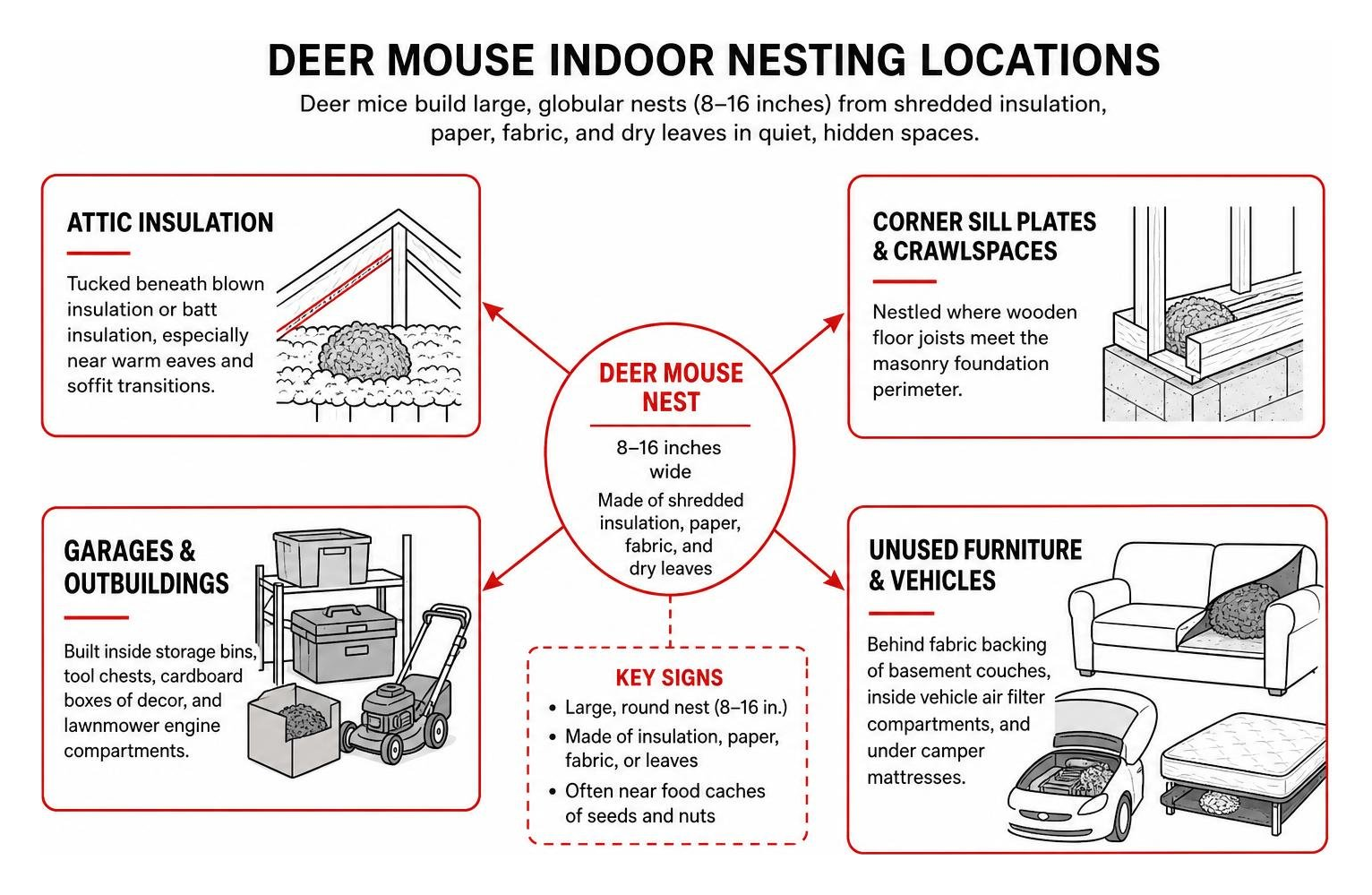
Common nesting hot spots include:
- Attic Insulation: Tucked directly beneath rolls of blown fiberglass or batt insulation, especially near the warm eaves and soffit transitions.
- Corner Sill Plates and Crawlspaces: Nestled right where the wooden floor joists meet the masonry foundation perimeter.
- Garages and Outbuildings: Built inside seldom-disturbed storage bins, tool chests, cardboard boxes of holiday decor, and lawnmower engine compartments.
- Unused Furniture and Vehicles: Behind the fabric backing of basement couches, inside vehicle air filter compartments, and under camper mattresses left vacant between seasons.
Hantavirus Risks and Safe Cleanup Protocols
The primary danger associated with deer mice is their role as the natural reservoir for the Sin Nombre virus, the pathogen responsible for Hantavirus Pulmonary Syndrome (HPS). According to long-term surveillance data, HPS is a severe, often fatal respiratory condition with a mortality rate of approximately 36 percent. The CDC reports 890 cases of hantavirus disease in the United States since tracking began, and while cases are concentrated in western rural regions, the ubiquitous distribution of deer mice makes proper safety measures non-negotiable everywhere they thrive. Review rodent health hazard data from PestWorld to learn more about the broader medical impacts of these woodland pests.
The virus is shed in the live animal’s urine, droppings, and saliva. It does not require a direct rodent bite to infect humans; rather, transmission almost always occurs through inhalation of airborne viral particles. When dried droppings, urine stains, or contaminated nesting materials are disturbed by sweeping or dry vacuuming, microscopic viral particles become suspended in the air, where they can be inhaled into the lungs.

Whenever you clean areas where deer mice have lived, you must wear appropriate Personal Protective Equipment (PPE):
- Rubber, latex, or nitrile gloves: Essential for preventing hand contamination.
- Respiratory Protection: An airtight, properly fitted N95 respirator mask (or a half-face respirator equipped with HEPA P100 filters for heavy attic contamination).
- Protective Eye Goggles: Unvented goggles keep airborne dust out of your eyes.
- Long Sleeves and Pants: Protect exposed skin, and wash your clothing in hot water immediately after cleanup.
Disinfection Steps Before Dropping Removal
Cleaning up deer mouse waste safely requires a strict “wet-clean” protocol. Never reach for a household broom or standard upright vacuum cleaner.

Follow these disinfection steps to protect your household:
- Air Out the Enclosed Space: At least 30 minutes before cleaning, open all exterior doors and windows to cross-ventilate the room. Turn off HVAC systems so contaminated dust cannot circulate through your ductwork. Leave the room while it airs out.
- Mix Your Disinfectant: Prepare a fresh bleach solution containing 1.5 cups of household bleach per gallon of water (a 1-to-9 ratio of bleach to water), or use an EPA-registered commercial disinfectant rated for viral pathogens.
- Saturate the Waste (Wet It Down): Gently spray the droppings, urine tracks, and nesting materials until they are completely soaked. Do not mist with high pressure, which can blow dried particles into the air. Let the disinfectant soak the material for at least 5 to 10 minutes to kill active viral strains.
- Wipe Up with Paper Towels: Using gloved hands, collect the soaked droppings and debris with damp disposable paper towels.
- Double-Bag All Debris: Place the soiled paper towels, droppings, and nest remnants directly into a heavy-duty plastic garbage bag. Seal the inner bag tightly, place it inside a second trash bag, and tie that securely before placing it in an outdoor, lidded waste bin.
- Disinfect the Surrounding Surfaces: Mop the entire floor and wipe down adjacent baseboards or shelving with the bleach solution.
- Decontaminate Your Gear: Wash your gloved hands with soap and water or spray them with disinfectant before peeling the gloves off inside-out. Dispose of the gloves, and wash your bare hands thoroughly with antibacterial soap and warm water.
Safe Trapping Protocol for Deer Mice in House Spaces
When dealing with deer mice indoors, trap selection and placement are critical. You must never use glue boards or live-catch traps. When a deer mouse is caught on a glue board, it thrashes in panic, emptying its bladder and bowels across the tray. This reaction drastically increases the volume of infectious urine droplets and airborne virus particles in your home.
Similarly, catch-and-release live traps are counterproductive. Controlled scientific research demonstrates that deer mice have an extraordinary homing instinct. Studies tracking released deer mice revealed that they routinely navigate return journeys of at least 394 meters, with test mice returning across rugged terrain from up to 1,200 meters away within 24 hours. Releasing a live deer mouse in your backyard guarantees it will re-enter your house within days.
The safest, most effective tool is the classic wooden or heavy-duty plastic snap trap:
- Placement: Position traps perpendicular to walls with the trigger facing the baseboard. Deer mice rarely run across open floors; they trace wall perimeters. Space traps every 5 to 10 feet in active areas such as attics, garages, and basements.
- Baiting Tactics: Use a pea-sized dab of sticky peanut butter, hazelnut spread, or rolled oats pressed into the trigger. Avoid loose birdseed, which they can gingerly pluck off without releasing the trip mechanism.
- Handling Catches: When inspecting traps, wear gloves, spray the dead rodent and the trap thoroughly with disinfectant solution, and place the carcass inside a sealed double bag for disposal.
If managing snap traps and biohazard waste is overwhelming, our team provides targeted residential pest management services across Wake, Durham, and surrounding counties to eliminate rodent threats safely.
Exclusion and Long-Term Prevention Strategies
Trapping only solves half the equation. If you remove the mice inside but leave exterior gaps unsealed, new woodland invaders will move into the warm nesting voids left behind. Exclusion is the only permanent solution for managing deer mice.
Deer mice have compressible ribcages and can squeeze through any exterior gap larger than 1/4 inch—roughly the diameter of an ordinary pencil or dime. Standard expanding polyurethane foam from a can is not sufficient on its own, as mice can chew right through dried foam in minutes.
Key exclusion steps include:
- Foundation and Weep Holes: Fill structural gaps, brick weep holes, and siding gaps using stainless steel wire mesh, heavy galvanized hardware cloth (1/4-inch or smaller weave), or copper mesh, secured firmly with premium silicone- or polyurethane-based exterior caulk.
- Door Sweeps and Weatherstripping: Install heavy-duty, metal-backed brush door sweeps on all exterior thresholds, garage doors, and basement walkouts. Ensure no light shows beneath the bottom seal.
- Utility Line Penetrations: Inspect where air conditioning conduits, electrical feeds, gas lines, and plumbing pipes penetrate exterior walls. Pack the perimeter of each pipe tightly with copper mesh and seal with high-grade mortar or exterior elastomeric sealant.
- Rooflines and Soffits: Inspect roof-fascia intersections, ridge vents, dormer transitions, and attic gable vents. Cover all attic vents with 1/4-inch galvanized wire screening.
Eliminating Exterior Attractants and Wooded Perimeters
Because deer mice primarily inhabit natural woodlands, fields, and rural brush, houses backing up to greenways and wooded lots face high seasonal pressure. You must make the immediate perimeter of your home inhospitable to foraging rodents:
- Maintain a 20-Foot Perimeter Buffer: Keep tall grasses mowed low and remove dense groundcovers like English ivy or juniper beds planted directly against foundation walls.
- Elevate and Relocate Firewood: Store stacked firewood at least 20 feet away from your home, elevated at least 18 inches off the ground on a metal stand.
- Manage Food Sources: Avoid open-tray bird feeders near the foundation, as fallen seed hulls create prime feeding grounds. Store wild birdseed, grass seed, and pet kibble inside heavy, airtight galvanized metal or thick plastic storage drums with clamp-down lids.
- Trim Overhanging Foliage: Cut tree limbs and shrub branches back at least 6 to 8 feet from gutters and rooflines to sever aerial highway access into your attic.
Safe Removal of Outdoor Nesting Sites
Outdoor structures such as detached garden sheds, pole barns, woodpiles, and unused vehicles serve as secondary staging grounds for deer mouse colonies.
- Vehicle Protection: If you store a camper, lawn tractor, or classic vehicle in an outbuilding, regularly inspect the engine bay and cabin air filter housing. Deer mice frequently shred hood insulation to build warm nests directly over engine manifolds.
- De-clutter Storage Outbuildings: Keep tools, lawn supplies, and equipment stored up on metal shelving rather than piled directly on concrete or dirt floors.
- Maintain Ongoing Perimeter Protection: Pairing outdoor habitat reduction with our comprehensive routine pest control plans ensures seasonal protection around the entire perimeter of your property year-round.
Professional Remediation vs. DIY Control
While a single mouse in a garage may be resolved with a few well-placed snap traps and a tube of sealant, larger infestations require professional equipment and expertise.
Attic cleanups present unique hazards. When deer mice settle into blown-in insulation, their urine and feces permeate the insulation material, turning the entire attic floor into a biohazard reservoir. Attempting to vacuum or rake contaminated insulation without specialized commercial-grade negative-air containment equipment can pump hantavirus particles straight through ceiling fixtures and into your living rooms.
Eliminating Severe Colonies of Deer Mice in House Settings
When you partner with Capital Pest Services, our team implements a comprehensive integrated pest management approach tailored to North Carolina homes:
- Comprehensive Structural Inspection: We inspect your home from the crawlspace to the highest roof ridge, identifying entry gaps, tracking trails, and hidden nesting pockets.
- Multi-Point Exclusion: Our technicians seal foundation voids, utility penetrations, roof transitions, and crawlspace vents using heavy-duty, rodent-proof materials.
- Safe Trapping and Biohazard Remediation: We deploy targeted mechanical traps in strategic, out-of-reach locations and provide full sanitization options for damaged insulation.
- Tamper-Resistant Exterior Defense: We position secure, lockable perimeter bait stations to intercept woodland rodents before they can access your foundation.
For ongoing issues, trust our professional rodent control solutions to permanently secure your home.
Frequently Asked Questions About Deer Mice
How can I tell deer mouse droppings from house mouse droppings?
Deer mouse droppings are smooth, dark pellets measuring roughly 3 to 6 millimeters (1/8 to 1/4 inch) in length with distinctly pointed ends. House mouse droppings are comparable in size (about 1/4 inch) but tend to be slightly duller with blunt or tapered ends. Because waste appearance can overlap depending on diet, look for nearby food hoards (like piles of seeds or acorns) or physical sightings of the mice to confirm the species.
Why is live trapping not recommended for deer mice?
Live trapping is ineffective and dangerous for two main reasons. First, deer mice have an exceptional homing instinct; field studies show they can navigate back to a home structure from over 394 meters (and up to 1,200 meters) away within hours. Second, handling a live, frightened deer mouse inside a trap increases your risk of exposure to aerosolized urine and bite wounds that carry pathogens. Snap traps provide a rapid, clean capture without the risk of the pest returning.
How do deer mice enter homes from wooded areas?
Deer mice are skilled climbers and agile jumpers. They enter homes through gaps as small as a quarter-inch around foundation sill plates, crawlspace access doors, dryer vents, and brick weep holes. They also climb tree branches, trellises, and masonry walls to find openings around roof eaves, soffits, and fascia boards.
Conclusion
Finding signs of deer mice inside your home can be unnerving, especially given the serious health risks associated with hantavirus. However, by avoiding dry sweeping, utilizing the proper wet-clean disinfection methods, deploying targeted snap traps, and sealing exterior gaps larger than 1/4 inch, you can safely eliminate active rodents and protect your home from future invasions.
If you suspect a rodent colony in your attic, crawlspace, or living areas, do not leave your family’s health to chance. Schedule expert rodent control with Capital Pest Services today, and let our licensed, local specialists restore clean, pest-free comfort to your home.
Capital Pest is proud to be a family-owned and operated pest control company serving Raleigh, NC and its surrounding area (Chapel Hill, Wake Forest, Clayton, Pinehurst, Pittsboro, Fuquay-Varina, etc). Contact us for our pest control services today!