Rats in Cavity Walls: Removal Techniques That Prevent Foul Odors
How Rats Invade and Nest in Wall Cavities
To remove rats from cavity walls without foul odors, avoid using poison inside wall voids. Instead, use targeted snap traps placed along known travel corridors, install temporary one-way exit doors over the primary exterior entry point, and then seal all structural openings with rodent-resistant materials. This approach lets rats leave to forage while preventing their return, and it allows prompt carcass retrieval if a rat dies in an accessible location.
Cavity walls consist of an inner and outer structural layer separated by a hollow space, usually filled with thermal insulation. While this design is ideal for home energy efficiency, rodents view it as prime real estate: a dark, sheltered superhighway running right through the heart of your home.
During cooler months, wall voids act as thermal refuges. The heat radiating from living spaces keeps these hollow gaps significantly warmer than outside conditions. Because the area is undisturbed by humans or pets, rodents can establish nests, raise young, and travel freely between rooms and floors.
Rats can enter a structure through remarkably small openings. Adult rats require an opening of only about half an inch (around 13 mm) to squeeze their bodies through, while juvenile rats can exploit openings as small as 10 mm. Common structural routes include:
- Utility penetrations: Gaps around exterior air conditioning conduits, gas lines, plumbing lines, and electrical conduits.
- Weep holes: Unscreened drainage openings in brick veneer construction at foundation level.
- Roofline and soffit gaps: Openings at fascia boards, roof junctions, or damaged soffit vents accessible via overhanging vegetation.
- Crawl spaces and subfloors: Unsealed foundation vents, dirt crawl floors, or missing vapor barriers that let rodents burrow directly beneath wall footing lines.

The Drain-to-Wall Pipeline: Faulty Sewer Lines
Many homeowners assume rats enter exclusively through exterior foundation cracks or rooflines. However, drainage infrastructure is often the true starting point. Industry findings show that more than 80% of indoor rat infestations originate from faulty, damaged, or redundant drainage pipes.
When underground sewer or waste lines develop cracks, displaced joints, or open, unused capped branches, rats utilize them as subterranean corridors. They burrow through softened soil around broken pipes and emerge beneath subfloors or directly into cavity walls through utility service penetrations.
Because these defects are buried underground, the problem cannot be resolved by merely baiting inside living areas. Diagnosing these hidden ingress routes often requires a CCTV drain survey to inspect the pipe interior and identify broken lines. Installing mechanical barriers, such as a stainless steel rat flap or non-return valve, physically prevents rodents from moving up the sewer line while permitting normal wastewater flow.
Telltale Signs of Rats in Cavity Wall Spaces
Detecting pests inside structural cavities relies heavily on auditory, visual, and olfactory cues:
- Acoustic Scratching Sounds: Nocturnal scratching, gnawing, and scurrying sounds behind baseboards or within ceilings. Rats produce heavier, rhythmic thumping and grinding sounds compared to the light skittering of mice.
- Grease Rub Marks: Rodent fur carries natural oils and dirt. Over time, repeated travel creates dark, waxy smudges along baseboards, wall corners, and utility pipe access points.
- Droppings: Rat droppings are typically 10 to 15 mm in length with blunt ends, frequently left along hidden runways near pipe cutouts.
- Pungent Ammonia Odors: A persistent, musky urine smell that builds up in poorly ventilated wall voids.
- Damaged Insulation: Shredded fiberglass or cellulose insulation pulled down to build nests, reducing the home’s thermal efficiency.
How to Get Rid of Rats in Cavity Wall Voids Without Creating Dead Animal Odors
Eliminating rodents from wall voids requires a methodical approach that prioritizes carcass retrieval. Introducing rodenticides directly into closed cavities often leads to rats dying deep within wall voids, creating a severe odor issue that can linger for weeks.
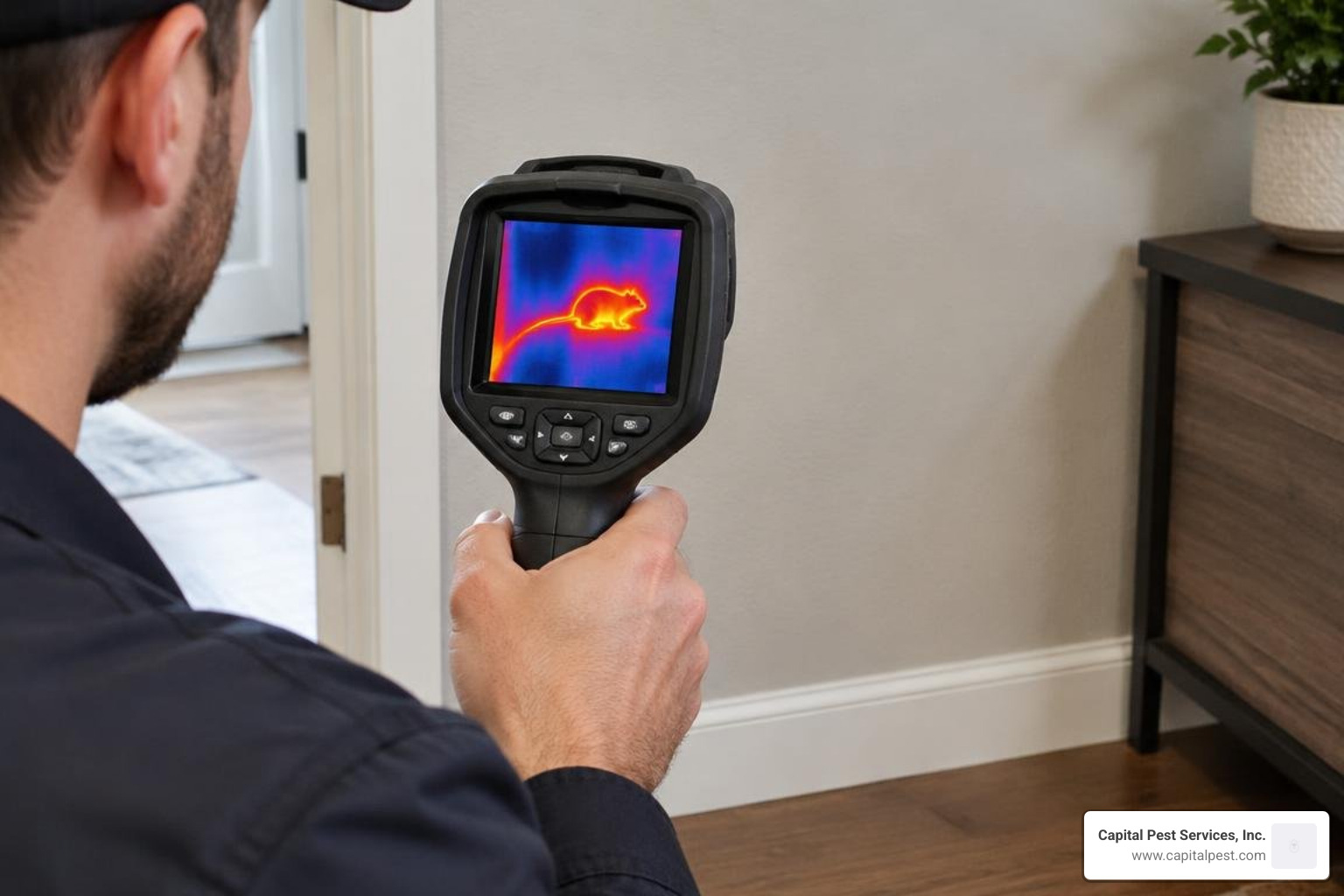
A targeted strategy begins with non-invasive detection. Using acoustic listening devices and high-resolution thermal imaging cameras allows technicians to detect thermal differences caused by rodent activity behind drywall or lath-and-plaster. When a precise location must be confirmed without unnecessary demolition, drilling a single 10 mm micro-borehole allows a flexible borescope camera to inspect the interior cavity directly.
Why Trapping Is Safer Than Poison for Rats in Cavity Wall Spaces
Rodenticides carry major drawbacks when used inside wall spaces:
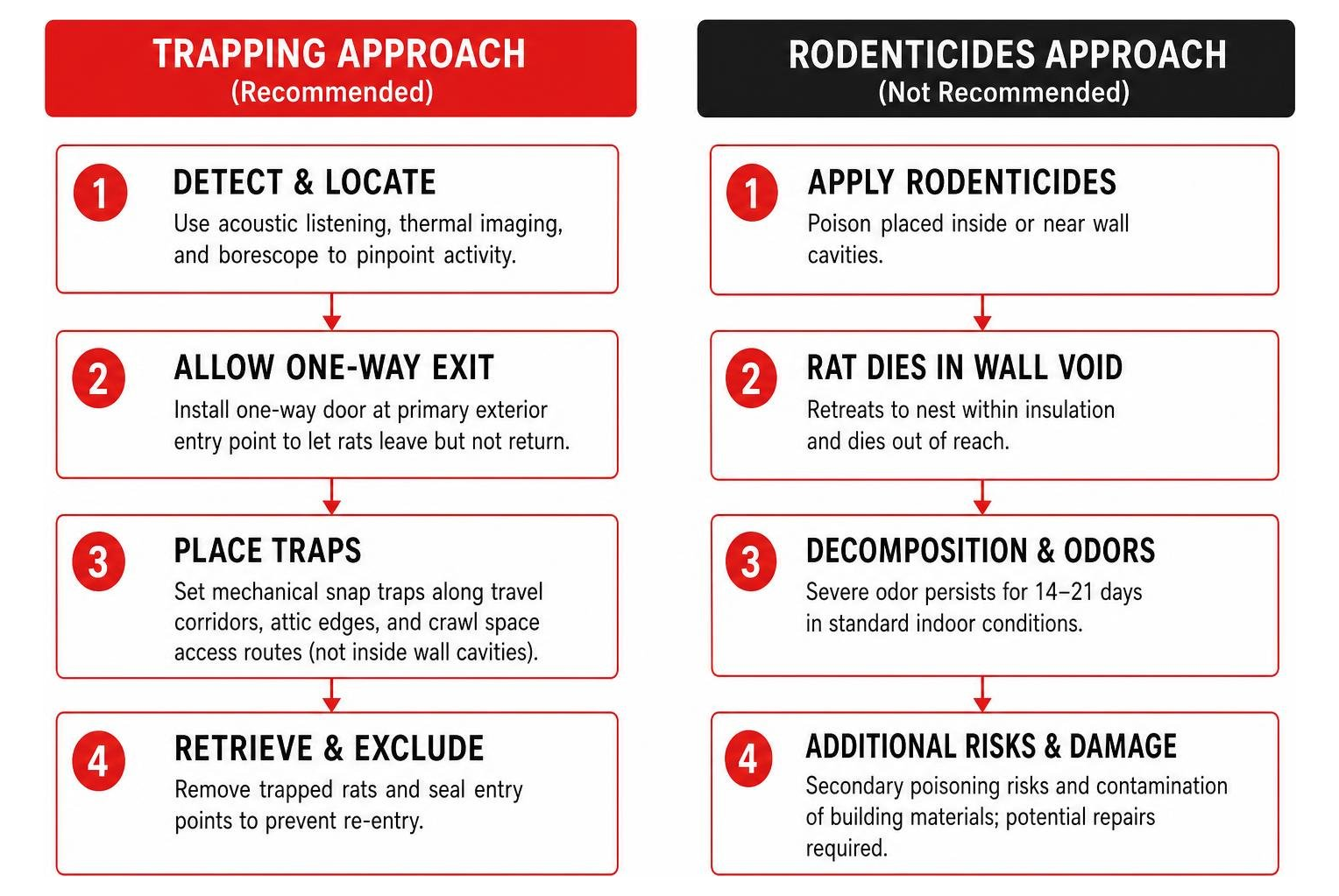
- Uncontrolled Decomposition: A poisoned rat will often retreat to its nest deep within insulation to die. In standard indoor conditions, a decomposing rat produces a severe odor that typically persists for 14 to 21 days.
- Environmental & Secondary Hazards: Poisoned rodents that manage to leave the structure present secondary poisoning risks to local wildlife and neighborhood pets.
- Building Material Contamination: Body fluids from decomposing rodents can seep into drywall, baseboards, and ceiling plaster, necessitating structural repairs.
The safest, most reliable method for indoor infestations is combining mechanical snap traps with temporary one-way wildlife doors. Installing a one-way door over the primary exterior entry point allows rats to exit the wall cavity to forage while physically blocking their return.
Traps should be placed along known travel corridors, attic edges, and crawl space access routes rather than inside sealed wall cavities. For complex structural infestations, utilizing professional rodent control ensures proper trap placement, routine carcass retrieval, and strategic exclusion without introducing foul odors into your home.
Locating and Removing Trapped Rodents
If a rodent has died inside a wall, prompt removal is essential to avoid secondary infestations of blowflies, skin beetles, and mites.
- Precise Extraction: Using thermal imaging or a borescope to locate the exact position minimizes structural damage. A small, neat drywall cutout can be made directly over the carcass to remove it along with any soiled insulation.
- Surface Sanitization: The interior void should be treated with an industrial enzymatic cleaner to break down organic proteins, urine deposits, and pheromone trails.
- Odor Neutralization: Odor molecules embedded in surrounding woodwork and plaster must be neutralized rather than masked. Standard household cleaners such as bleach do not eliminate these organic compounds; specialized counteractants or professional ozone treatments are necessary to restore air quality.
Comprehensive Rat-Proofing and Structural Exclusion Techniques
Eliminating current activity is only half the battle. Permanent control requires comprehensive structural exclusion (rat-proofing) to ensure new rodents cannot exploit the same pathways.
Material Selection for Wall Exclusion
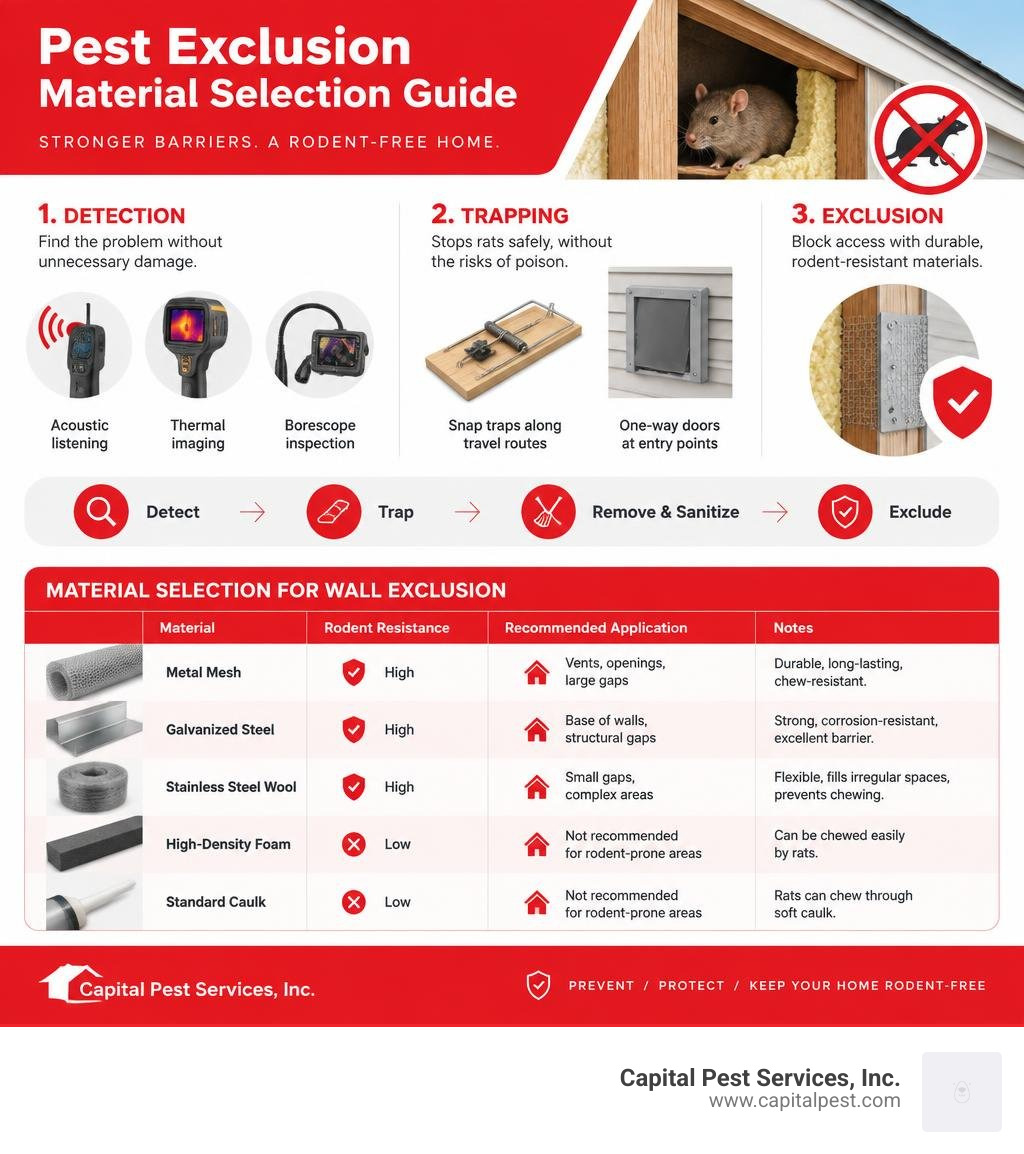
Not all construction materials resist rodent teeth. Rats possess strong incisors that can chew through soft plastics, expanding foam, wood, and standard caulk.
| Material | Rodent Resistance | Recommended Application | Notes |
|---|---|---|---|
| Stainless Steel Mesh / Hardware Cloth (1/4″) | Excellent | Foundation vents, large crawl space openings, roof gaps | Resists rust and cannot be gnawed through. |
| Copper Mesh (Stuf-fit) | Excellent | Narrow weep holes, tight gaps around exterior pipe lines | Packs tightly into gaps; will not rust or stain brick. |
| Standard Expanding Foam | Poor (alone) | None (without reinforcement) | Rats easily chew through foam; must be backed by wire mesh. |
| Stainless Steel Rat Flaps | Excellent | Main sewer connections and branch lines | Allows one-way flow of wastewater while blocking drain ingress. |
| Sheet Metal / Flashing | Excellent | Door corners, fascia interfaces, siding joints | Heavy-gauge steel or aluminum stops gnawing at low clearances. |
Sealing Exterior Openings and Weep Holes
To protect brick veneer homes, install commercially manufactured stainless steel weep hole covers. These specialized inserts allow moisture to drain and air to circulate freely while blocking rodents from entering the wall cavity.
For pipe penetrations and utility conduits, pack openings with tightly woven copper mesh or stainless steel wool before applying an exterior-grade polyurethane sealant or hydraulic cement. Additionally, maintain at least three feet of clearance between overhanging tree limbs and the roofline to prevent roof-dwelling rodents from accessing soffits and attic voids.
Securing vulnerable ground-level entryways with dedicated residential pest control measures provides a durable defense across foundations, crawl spaces, and exterior walls.
Frequently Asked Questions About Rats in Wall Cavities
How long does a dead rat smell persist inside a wall?
Under standard indoor conditions, a dead rat odor typically lasts between 14 and 21 days. The duration depends on the animal’s size, ambient temperature, humidity levels, and airflow within the wall void. High indoor humidity or damp insulation can slow the desiccation process, prolonging the odor for more than four weeks if left untreated. Professional removal and enzymatic treatment are recommended to clear the air quickly.
Can rats chew through electrical wires and drywall inside cavity walls?
Yes. Rodents must constantly gnaw on hard materials to wear down their continuously growing incisors. Inside wall cavities, rats routinely chew through fiberglass insulation, PEX plumbing lines, drywall, and plastic sheathing on electrical wiring. Damaged electrical wires create hidden short circuits and serious structural fire risks, making prompt management crucial.
When should I schedule a CCTV drain survey for rats?
A CCTV drain survey is recommended if you experience recurrent rodent activity in your walls despite sealing exterior above-ground entry points, or if you hear scratching beneath ground-floor rooms. A drain camera inspection identifies cracked clay joints, uncapped redundant pipe runs, and compromised sewer connections, allowing targeted repairs and the installation of a non-return rat valve to solve the root problem.
Conclusion
Managing an infestation inside wall cavities requires a balance of proper diagnosis, strategic trapping, and durable structural exclusion. Relying on poisons often leads to dead animals trapped behind drywall, resulting in severe odors, insect activity, and indoor air contamination.
By identifying entry points, utilizing mechanical trapping or one-way exclusion doors, and permanently sealing foundations and utility conduits, you protect your property from costly structural damage and recurring infestations.
At Capital Pest Services, Inc., we apply integrated pest-management strategies to locate, remove, and exclude rodents from residential properties across Raleigh, Durham, Cary, Chapel Hill, and the surrounding Triangle communities. Contact our team today to schedule an inspection and protect your home with lasting, odor-free rodent solutions.
Capital Pest is proud to be a family-owned and operated pest control company serving Raleigh, NC and its surrounding area (Chapel Hill, Wake Forest, Clayton, Pinehurst, Pittsboro, Fuquay-Varina, etc). Contact us for our pest control services today!