Making Mountains Out of Mounds: How to Flatten Ant Hills in Your Yard
Why Do Ant Hills in Yard Turf Keep Appearing?
To flatten ant hills in your yard and keep them from returning, level the dry surface soil with a rake or broom, then apply a slow-acting granular bait around the mound perimeter so foraging workers carry the active ingredient down to the queen. This two-step approach protects your turf while collapsing the colony over two to four weeks. For aggressive fire ant mounds in high-traffic areas, a targeted liquid drench can eliminate the nest within 24 to 48 hours.
Few sights frustrate a dedicated homeowner quite like waking up to find pristine turf interrupted by fresh piles of excavated soil. While it may look like random vandalism from the insect world, mound construction serves vital biological purposes for the colony.
Ants are subterranean engineers. As worker ants tunnel beneath your turf to create living quarters, nurseries, and storage hubs, they push excess dirt, sand, and organic debris upward to clear pathways. Beyond simple soil removal, that above-ground mound acts as a solar radiator and a roof. It captures radiant heat from the sun to warm the delicate eggs and larvae stored just beneath the surface, while the sloped design sheds excess rainwater away from the central nesting chambers.
The Underground Architecture of an Ant Colony
The mound you see on your grass is truly just the tip of the iceberg. The visible dirt represents roughly 5% to 10% of the entire nest structure. Below the surface lies an extensive labyrinth of interconnected galleries, tunnels, and specialized rooms extending deep into the earth.
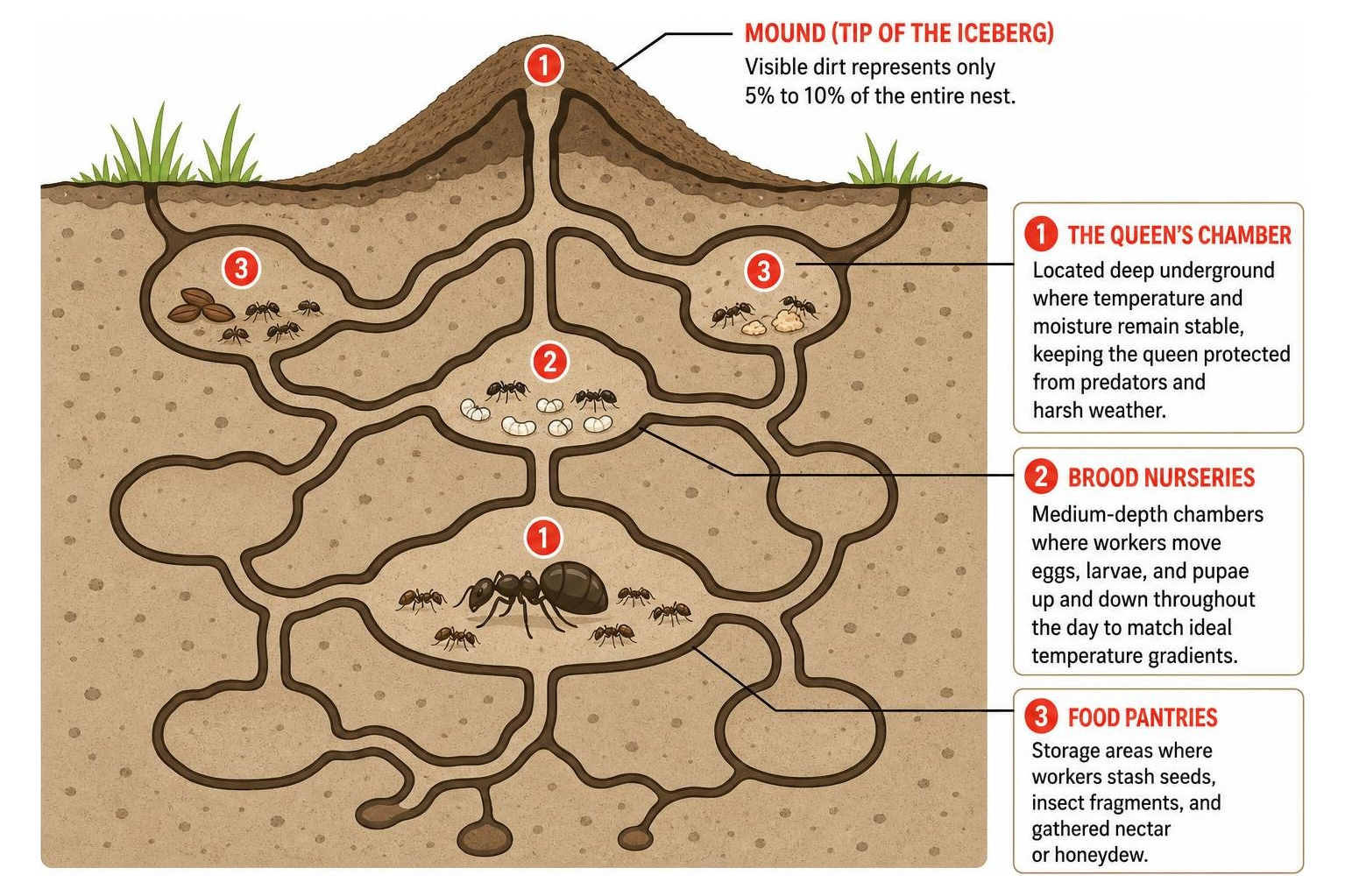
In established nests, vertical tunnels can plunge several feet into the subsoil—and in some species, deeper than 10 to 20 feet horizontally and vertically. The subterranean architecture includes:
- The Queen’s Chamber: Located deep underground where temperature and moisture remain stable, keeping the queen protected from surface predators and harsh weather.
- Brood Nurseries: Medium-depth chambers where workers constantly move eggs, larvae, and pupae up and down throughout the day to match ideal temperature gradients.
- Food Pantries: Storage areas where workers stash seeds, insect fragments, and gathered nectar or honeydew.
- Ventilation Shafts: Carefully maintained air channels that cycle oxygen through the nest and regulate humidity.
Because the vital reproductive center of the colony is insulated deep underground, merely sweeping away or stomping on the surface dirt does nothing to stop the colony from functioning.
Environmental Triggers: Rain, Soil, and Food Sources
Ant activity often seems to surge out of nowhere, but specific environmental triggers drive rapid mound building:
- Heavy Rainfall: Saturated soil floods lower chambers, prompting worker ants to move the brood upward. Mounds can erupt across a lawn within 24 hours after a soaking rain as ants rebuild collapsed entryways and dry out their young.
- Loose, Sandy, or Compacted Soil: Thin turf with compacted or sandy soil provides ideal structural stability for digging while offering minimal root competition.
- Honeydew-Producing Insects: Aphids, mealybugs, and soft scales feeding on nearby ornamental trees and shrubs excrete sugary honeydew. Ants actively protect these garden pests to harvest the honeydew, providing an abundant energy source that fuels colony expansion.
- Yard Debris and Moisture Leaks: Over-irrigated zones, dripping hose spigots, fallen fruit, spilled birdseed, and decaying wood piles offer immediate food and water.
Common Lawn Ant Species and How to Identify Them
Before grabbing a rake or an insecticide, you must know what species is building on your lawn. Treating a harmless native ant the same way you treat an aggressive, stinging colony can backfire, sometimes eliminating natural competitors and opening territory for worse pests. Homeowners looking to protect their grass can explore Southern Living pest prevention recommendations alongside the identification tips below.
Identifying Common Species Creating Ant Hills in Yard Spaces
Several distinct species regularly nest in residential lawns across our service areas, ranging from Cary and Apex to Wake Forest and Chapel Hill:
- Turfgrass Ants (Lasius neoniger): Tiny, light-to-medium brown ants (roughly 1/8 inch long) that build miniature craters of fine soil across sunny lawns. They feed largely on honeydew and small insects.
- Field Ants (Formica spp.): Larger ants (1/4 to 1/2 inch) ranging from black to reddish-brown. They construct broad, low-profile mounds up to a foot or more across, frequently positioned near lawn borders, fence lines, landscape timbers, or old tree stumps. They can deliver a pinch with their mandibles and spray formic acid if sat upon, but they rarely bite unless heavily provoked.
- Pavement Ants (Tetramorium immigrans): Small, dark brown-to-black ants (1/8 inch) that push neat, volcano-like craters of sand and fine dirt through expansion joints in sidewalks, driveways, patios, and along masonry edges.
- Odorous House Ants (Tapinoma sessile): Small (1/8 inch), brownish-black ants known for emitting a pungent, rotten-coconut odor when crushed. While they often forage indoors, they readily nest under lawn mulch, rocks, and shallow turf.
- Argentine Ants (Linepithema humile): Dull brown, 1/8-inch ants that form massive multi-queen supercolonies with shallow, interconnected foraging networks rather than distinct, single mounds.
| Ant Species | Mound Appearance | Worker Size | Sting / Bite Hazard | Colony Size |
|---|---|---|---|---|
| Turfgrass Ant | Tiny, fine-soil craters (1–3 in.) | ~1/8 inch | None; non-aggressive | Thousands |
| Field Ant | Wide, flattened mounds (up to 12+ in.) | 1/4 to 1/2 inch | Mild bite; sprays formic acid | Hundreds to thousands |
| Pavement Ant | Small sand volcanoes along cracks | ~1/8 inch | Rare; negligible | 3,000 to 10,000 |
| Red Imported Fire Ant | Large, dome-shaped mounds; no center hole | 1/16 to 1/4 inch (polymorphic) | Severe; painful, burning stings | 100,000 to 500,000+ |
Harmless Native Mounds vs. Dangerous Fire Ant Hills
Telling native lawn ants apart from Red Imported Fire Ants (Solenopsis invicta) is essential for household safety:
- Entrance Holes: Native ant mounds (such as pavement and turfgrass ants) feature an open, visible central entrance hole or crater at the top. Fire ant mounds do not have a visible entrance hole on top. Fire ants enter and exit via lateral subterranean foraging tunnels that surface several feet away.
- Mound Shape: Fire ant mounds can reach substantial sizes—up to 18 to 24 inches in diameter and 18 inches high—especially in undisturbed pastures or open lawn edges, forming dense, dome-shaped clusters of loose soil.
- Defensive Response: If you lightly disturb a native ant hill, worker ants will slowly scurry around to salvage brood. If you poke or step on a fire ant mound, hundreds to thousands of workers will boil out of the ground within seconds, aggressively climbing vertical surfaces to sting repeatedly.
- Beneficial Native Competitors: Harmless native species like pyramid ants (Dorymyrmex spp.) build small, neat volcano mounds and actively hunt and outcompete newly mated fire ant queens. Eradicating harmless native species can leave a biological void that invasive fire ants quickly fill.
Step-by-Step Guide: How to Safely Remove Ant Mounds and Target the Queen
Eliminating an unwanted mound requires a strategy that balances surface turf preservation with subterranean colony elimination. Implementing smart ways to control backyard pests helps maintain outdoor spaces without destroying your turfgrass.

Step 1: Physical Leveling and Turf Protection
If a mound is built by non-stinging species and is simply making your lawn look uneven or threatening to choke the grass, start with mechanical management:
- Wait until the mound soil is completely dry. Attempting to rake wet soil creates a muddy smear that suffocates grass blades.
- Use a stiff garden broom, leaf rake, or the flat back of a garden rake to gently disperse the loose dirt across the surrounding turf.
- Ensure the dispersed soil layer is less than 1/4 inch deep so sunlight still reaches the grass blades below.
- Leveling prevents the lawn mower from scalping the high spot and keeps sandy grit from dulling your mower blades.
Step 2: Applying Targeted Granular Baits and Drenches
Because leveling the dirt does not harm the underground queen, active colonies will rebuild the structure within a few days. You must introduce an active ingredient that worker ants carry directly into the nesting chambers.

- Slow-Acting Granular Baits: Baits formulated with active ingredients such as hydramethylnon, indoxacarb, or abamectin are the gold standard. Foraging workers mistake the bait granules for food and transport them down to feed the larvae and queen.
- Application Technique: Scatter the bait evenly around the perimeter of the mound along active foraging trails—never pour bait directly on top of the mound. Dumping bait directly on the mound disturbs the colony, causing workers to ignore or bury the granules.
- Timing: Apply bait during clear, dry weather in the morning or early evening when ground temperatures are warm and ants are actively foraging. Granular baits typically take 2 to 4 weeks to completely collapse an established colony.
- Targeted Mound Drenches: For aggressive fire ant mounds located in high-traffic play zones, waiting a month for bait may pose an unacceptable sting hazard. In these urgent cases, a targeted mound drench using a labeled liquid insecticide (such as bifenthrin) can eliminate the mound within 24 to 48 hours. Mix the specified volume with 1 to 2 gallons of water and slowly soak the mound from the outer perimeter inward to saturate the underground tunnels.
Step 3: Repairing Disturbed Lawn Patches
Once ant activity ceases, assess the turf beneath the old mound:
- Rake away any dead thatch or crusted soil.
- Topdress bare spots with a light blend of compost and quality topsoil.
- Overseed with turfgrass suited to our Piedmont climate (such as turf-type tall fescue for sun-and-shade lawns or warm-season varieties like bermudagrass or zoysia).
- Keep the patch consistently moist until the new seedlings establish a dense, competitive root system.
What Works vs. What Fails: Evaluating Home Remedies
The internet is filled with DIY concoctions claiming to obliterate ant mounds overnight. Unfortunately, many popular home remedies either fail completely or cause severe collateral damage to your lawn.
Natural vs. Ineffective Methods for Ant Hills in Yard Soil
| Remedy Method | Effectiveness on Colony | Turf Safety | Queen Elimination | Verdict |
|---|---|---|---|---|
| Borax & Sugar Liquid Bait | Moderate (Small Nests) | High | Possible | Effective if mixed at low (1-5%) toxicity |
| Diatomaceous Earth (DE) | Low to Moderate | High | Rare | Kills only surface workers on dry days |
| Vinegar / Bleach Pour | Low | Very Low (Kills Grass) | No | Destroys soil pH and scorches turf |
| Cornmeal / Grits | None (0%) | High | No | Total myth; ants cannot burst from grain |
| Boiling Water | Low to Moderate | Very Low (Scalds Grass) | Rare (Deep Queens Survive) | Kills surface workers; ruins root systems |
| Flooding with Garden Hose | Low | Moderate | No | Temporarily disperses ants; muddy mess |
- Boric Acid / Borax Solutions: Borax mixed with sugar water or peanut butter can work against sweet- and grease-feeding species. However, the concentration must remain low (around 1% to 5% active borax). If the mixture is too strong, worker ants die before they make it back to feed the queen.
- Diatomaceous Earth (Food Grade): DE works mechanically by abrading the insect’s waxy cuticle, causing dehydration. While it is non-toxic and lawn-safe, it only affects ants that physically walk over it, and it becomes completely ineffective as soon as it absorbs morning dew or irrigation.
- Cornmeal and Grits Myth: The persistent rumor that dry grits expand inside an ant’s stomach and explode is biological fiction. Adult ants cannot ingest solid food particles; they carry solid food to larvae, which digest it into liquid form. Feeding ants grits simply feeds the colony.
- Vinegar and Bleach: Pouring household cleaners or concentrated vinegar onto a mound will alter the soil chemistry, kill beneficial soil microbes, and leave brown, dead turf patches that take months to recover.
Risks of Boiling Water and DIY Chemical Mixtures
Pouring 2 to 3 gallons of boiling water onto a mound is frequently recommended as a “free and natural” solution. While boiling water will kill ants instantly on contact, its practical performance in a lawn is poor:
- Turf Root Scalding: Water at 212°F cooks root systems and surrounding turfgrass instantly, leaving an unsightly dead circular scar on your lawn.
- Thermal Dissipation: Soil absorbs and dissipates heat rapidly. By the time boiling water reaches subterranean depths of 12 to 24 inches, it has cooled to lukewarm temperatures, leaving the deep queen chambers untouched.
- Safety Hazards: Transporting multiple 3-gallon buckets of boiling water—weighing roughly 8 pounds per gallon—across an uneven yard poses a severe burn risk to the homeowner.
- Colony Splitting: When a colony senses thermal damage, surviving workers take the queen and remaining brood and excavate multiple new satellite mounds just a few feet away.
Long-Term Lawn Care and Integrated Pest Management Strategies
Managing ants on residential properties is not about sterilizing the soil; it is about creating an environment where healthy turf naturally resists infestation. Consulting university extension guidance on managing ant mounds provides excellent foundational principles for maintaining balanced turf biology. If seasonal pressure becomes severe, homeowners often turn to wipe out outdoor pests using yard sprays along perimeter turf lines to keep populations contained.
Cultural Turf Maintenance and Honeydew Control
Ants struggle to build visible mounds in thick, dense lawns with strong root canopies. Use these cultural lawn care practices:
- Mow at Optimal Heights: Maintain tall fescue at a height of 3.5 to 4 inches. Taller grass shades the soil surface, cooling the ground and discouraging sun-loving ant species from establishing nurseries.
- Deep, Infrequent Irrigation: Daily shallow watering keeps surface soil loose and damp, providing ideal construction material for mounds. Water deeply (1 to 1.5 inches per week in a single morning session) to force grass roots deeper and leave the upper soil surface dry.
- Core Aeration: Compacted soil with poor drainage encourages shallow nesting. Annual core aeration relieves compaction and promotes thick, resilient root growth.
- Manage Sap-Feeding Garden Pests: Inspect your ornamental plantings, crape myrtles, and foundation shrubs for aphids and soft scales. Washing these insects off with horticultural oils or insecticidal soaps removes the honeydew fuel supply that supports ant colonies.
Perimeter Barriers and Quarterly Prevention
A successful Integrated Pest Management (IPM) plan prevents outdoor lawn colonies from migrating toward your home’s foundation:
- Maintain a Clean Foundation Zone: Keep mulch, decorative stones, pine straw, and organic garden debris at least 6 to 12 inches away from your foundation walls.
- Spring Broadcast Treatments: In areas with heavy fire ant pressure, broadcasting an insect growth regulator (IGR) bait across the entire lawn once in early spring and once in late summer prevents newly mated queens from establishing successful colonies.
- Quarterly Monitoring Regimen: Because worker ants can forage hundreds of feet from adjacent properties, reinfestation often occurs within 6 to 8 weeks after single-spot treatments. Routine seasonal monitoring ensures new mounds are addressed while they are small.
Frequently Asked Questions About Ant Hills on Lawns
Will pouring boiling water permanently eliminate an ant hill?
No. Boiling water rarely achieves permanent colony elimination. While it kills surface workers on contact, the scalding water cools rapidly as it filters through dirt, leaving the queen alive in deep subterranean chambers. Additionally, boiling water instantly kills grass blades and cooks turfgrass root systems, resulting in large, dead brown patches.
Do ant hills actually damage lawn grass and root systems?
In small numbers, native ants do not directly feed on grass or eat living turf roots. In fact, their underground tunneling naturally aerates the soil, improves drainage, and recycles organic matter. However, large mounds damage lawns indirectly by smothering underlying grass blades, creating uneven ground that risks mower scalping, and drying out shallow roots where excessive tunneling creates underground air pockets.
When is professional pest control necessary for lawn ants?
DIY methods often fall short when dealing with widespread infestations, aggressive Red Imported Fire Ants, or species that form multi-queen supercolonies (like Argentine ants). If mounds consistently return after baiting, if stings threaten children and pets, or if ants begin establishing indoor foraging trails into your living spaces, choosing a local exterminator for your lawn ensures the infestation is addressed safely and completely with commercial-grade products.
Conclusion
Ant hills can quickly detract from a beautiful lawn, but attempting to flatten them without addressing the underground colony only leads to frustration. By properly identifying whether you are dealing with harmless native species or aggressive fire ants, leveling surface mounds to protect your turf, and utilizing slow-acting baits that reach the queen, you can restore a healthy, uniform yard.
Capital Pest Services, Inc. provides comprehensive residential and commercial pest management across Raleigh, Durham, Chapel Hill, Cary, Apex, Wake Forest, Holly Springs, Fuquay-Varina, Garner, Clayton, Knightdale, Zebulon, Wendell, Morrisville, Pittsboro, Sanford, Oxford, Franklinton, Youngsville, Rolesville, and Spring Hope. As an NPA-accredited company, our certified technicians combine eco-friendly methods and integrated pest management to keep your lawn and home protected all year long.
If stubborn ant mounds or fire ant colonies are taking over your yard, contact us today for professional ant control services and regain your outdoor peace of mind.
Capital Pest is proud to be a family-owned and operated pest control company serving Raleigh, NC and its surrounding area (Chapel Hill, Wake Forest, Clayton, Pinehurst, Pittsboro, Fuquay-Varina, etc). Contact us for our pest control services today!