

Finding a Reliable Licensed Exterminator in Raleigh Without the Hassle
How to Find a Reliable Licensed Exterminator in Raleigh
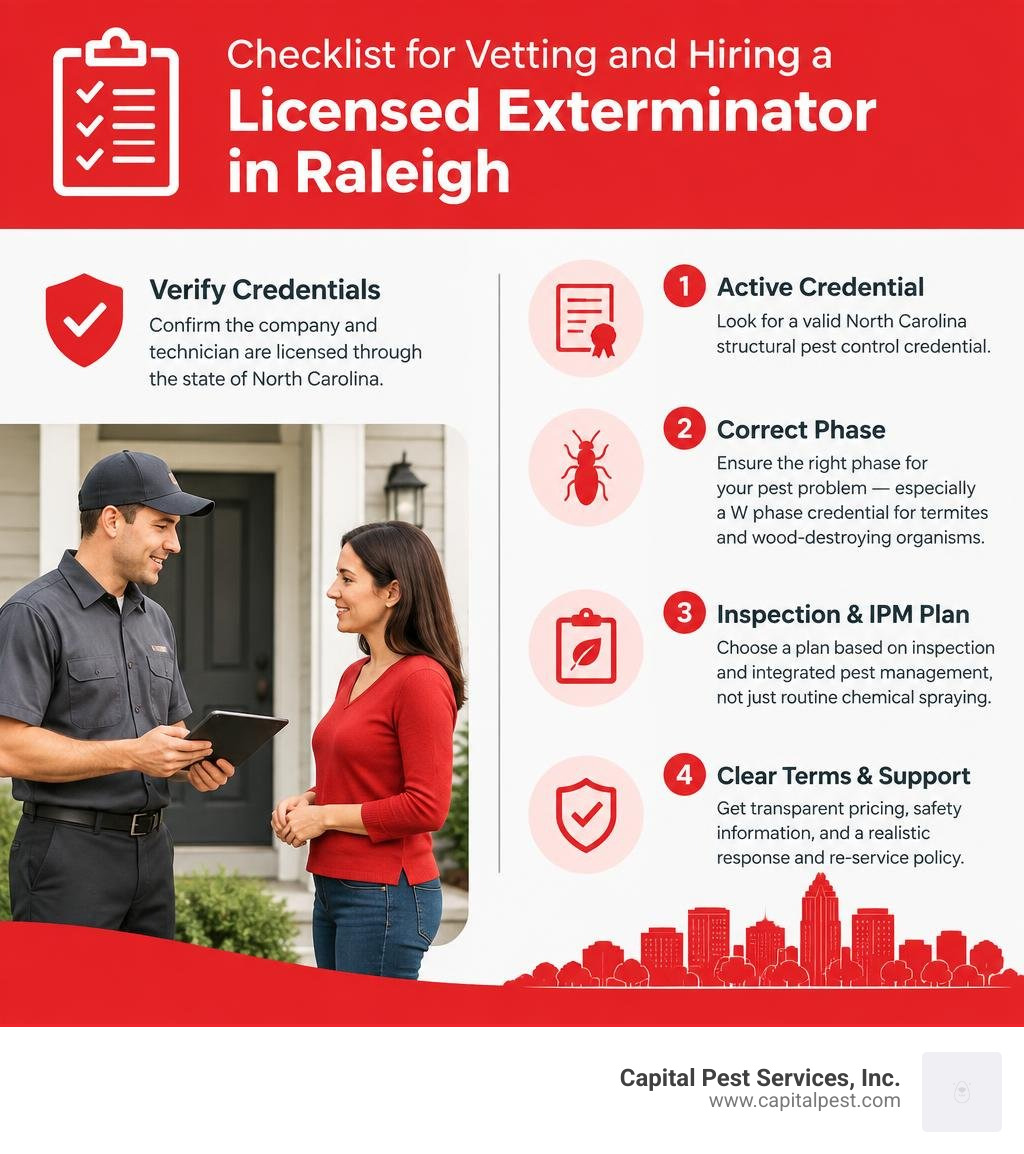
To hire a licensed exterminator in Raleigh, first verify the company and technician through the North Carolina Department of Agriculture and Consumer Services, then confirm they hold the right credential for your pest problem. Ask for a clear inspection, written treatment plan, and details about follow-up service before signing an agreement. For broader context on structural pest control standards, the North Carolina Department of Agriculture and Consumer Services provides regulatory guidance.
For a quick hiring check, make sure the provider can show:
- An active North Carolina structural pest control credential.
- The correct phase for the work – especially a W phase credential for termites and other wood-destroying organisms.
- A plan based on inspection and integrated pest management, not just routine chemical spraying.
- Clear pricing, safety information, and a realistic response and re-service policy.
Raleigh’s warm, humid conditions can support ants, mosquitoes, rodents, termites, and moisture-related pest issues for much of the year. Licensing matters because North Carolina separates routine household pest work from termite and wood-destroying organism services, and those differences can affect both your treatment and your home’s protection.
I am Mitch Taylor, President of Capital Pest Services, Inc., with more than 17 years in Triangle-area pest management and a focus on practical, eco-friendly integrated pest management. In this guide, I will show you how to evaluate a licensed exterminator Raleigh homeowners can trust for their specific pest issue.
North Carolina Pest Control Licensing Levels and Requirements
When dealing with pests, it is easy to assume that any pest control technician stepping onto your porch possesses the same general certification. However, the North Carolina Department of Agriculture and Consumer Services (NCDA&CS) Structural Pest Control and Pesticides Division enforces strict standards to ensure consumer protection and environmental safety.
Every individual applying pesticides commercially inside or around structures in North Carolina must carry a valid, state-issued identification credential. The state sets rigorous qualification bars, continuous safety compliance standards, and mandatory liability insurance coverage before a pest management company can legally dispatch technicians to service local homes and businesses.
Registered Technician vs. Certified Applicator vs. Licensee
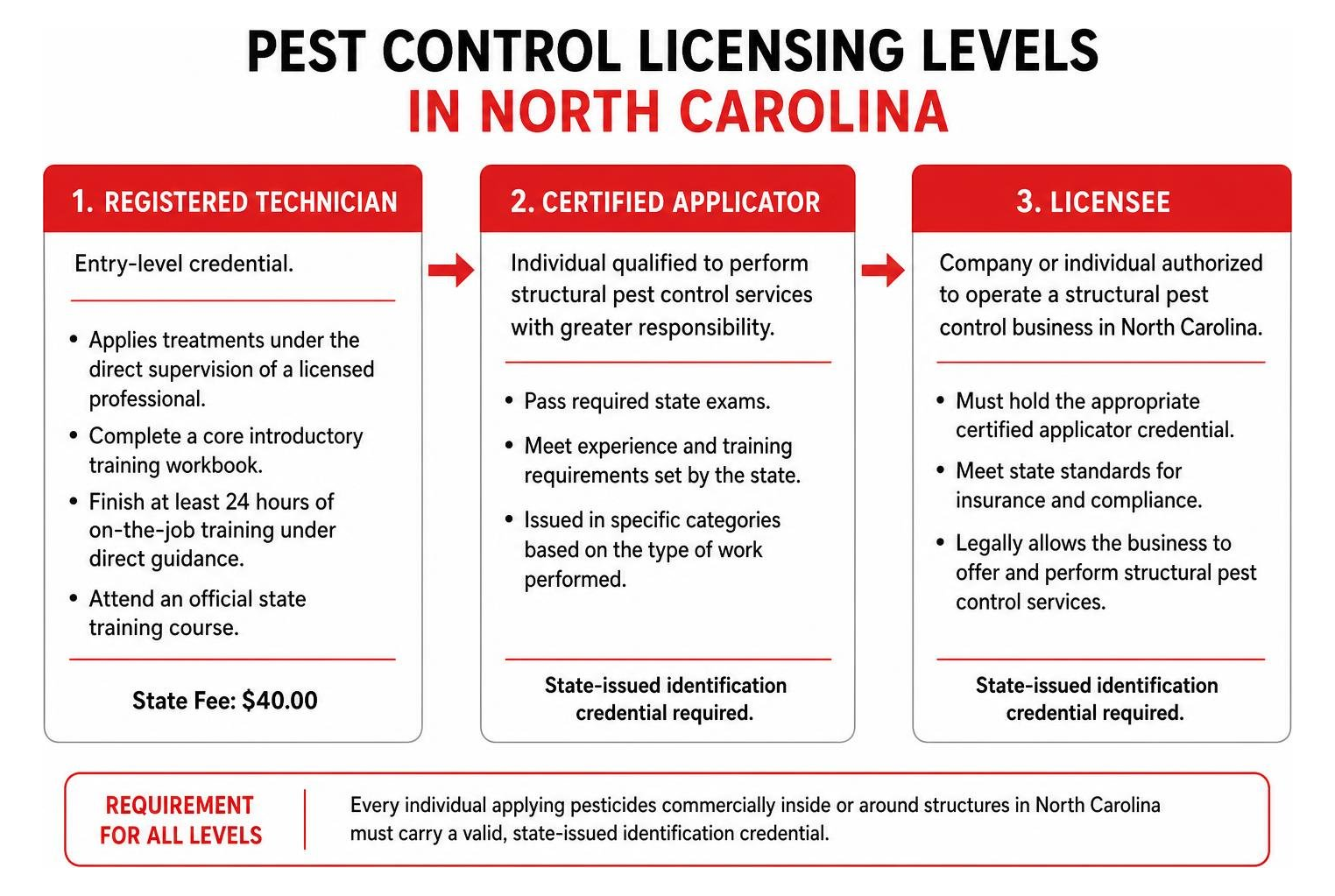
Understanding the hierarchy of structural pest control credentials helps you evaluate the experience level of the professional treating your home. North Carolina recognizes three primary credential tiers:
- Registered Technician: This entry-level credential allows an employee to apply treatments under the direct supervision of a licensed professional. To qualify, the technician must complete a core introductory training workbook, finish at least 24 hours of on-the-job training under direct guidance, and attend an official state training course. The state fee for a Registered Technician identification card is $40.00.
- Certified Applicator: A certified applicator has demonstrated high-level technical competency by passing comprehensive state examinations covering core pest management principles and specific treatment categories. They are authorized to use or supervise the use of restricted-use pesticides. The annual state fee for a Certified Applicator card is $50.00.
- Structural Pest Control Licensee: This is the highest professional designation. A Licensee carries legal and operational responsibility for the pest control company’s service offerings. Becoming a licensee requires at least two years of documented, hands-on industry experience (or specific formal education equivalents in entomology) and passing advanced phase exams. The annual structural pest control license fee is $200.00 for the first operational phase, plus $75.00 for each additional phase.
Structural Pest Control Phases for a Licensed Exterminator in Raleigh
North Carolina structural pest control credentials are split into distinct treatment categories known as “phases.” An exterminator certified in one phase is legally prohibited from providing commercial services in another unless they have passed the corresponding state examinations.
| Structural Phase | Phase Code | Scope of Authorized Work | Common Target Pests in Raleigh |
|---|---|---|---|
| Household Pest Control | P Phase | General indoor and perimeter structural pest prevention and remediation. | Roaches, ants, spiders, mice, rats, and stinging insects. |
| Wood-Destroying Organisms | W Phase | Inspection, structural prevention, and eradication of insects that feed on or damage wood structures. | Eastern subterranean termites, carpenter ants, powderpost beetles, and wood-boring pests. |
| Fumigation | F Phase | The containment and specialized application of gaseous fumigants inside enclosed structures or commodities. | Severe drywood insect infestations, commodity-infesting beetles, and specialized structural quarantine pests. |
Why does this matter to Raleigh homeowners? If you suspect subterranean termites are attacking your foundation or subflooring, hiring a technician who only holds a “P phase” certification is not sufficient. You need a professional holding a certified “W phase” credential to perform official wood-destroying organism (WDO) inspections, issue state-regulated closing reports, and apply structural termiticides safely.
Out-of-State Reciprocity and Annual Card Renewals
North Carolina maintains strict reciprocity standards. The state does not grant automatic licensing reciprocity for business licensees from other regions; however, the NCDA&CS does maintain Certified Applicator reciprocity agreements with four neighboring states:
- Kentucky
- South Carolina
- Tennessee
- Virginia
Applicators certified in these specific states can apply for reciprocal certification in North Carolina by presenting verified records of their out-of-state exams and standing.
Regardless of where an applicator originally trained, all structural pest control identification cards and licenses in North Carolina expire annually on June 30th. To maintain active standing, certified professionals must complete mandatory continuing education credits (CEUs) in safety, environmental stewardship, and integrated biology before renewing their credentials each year.
5 Essential Steps to Vet a Licensed Exterminator in Raleigh
Selecting the right pest control partner does not have to be stressful. By following a structured vetting protocol, you can avoid uncertified operators and ensure your property receives safe, effective, long-term protection.
1. Verify NCDA&CS Credentials and Phase Certifications
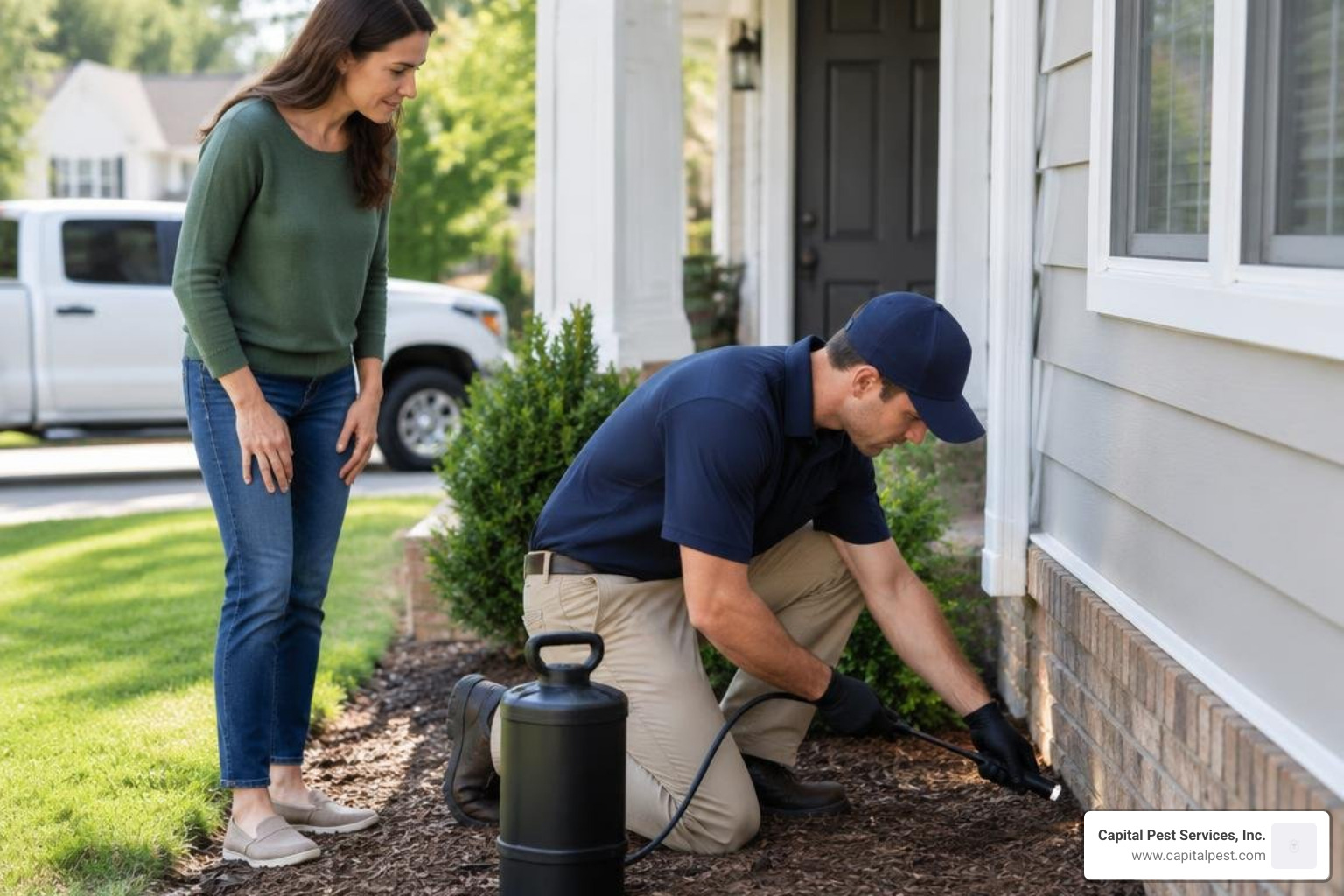
Never hesitate to ask a service professional for proof of certification. Every legitimate technician carries a physical or digital NCDA&CS identification card listing their name, authorized phases (P, W, or F), and current expiration date. You can also independently verify a company’s standing using the public license lookup tools provided by the North Carolina Department of Agriculture.
2. Evaluate Response Times and Integrated Pest Management Practices
When pests invade your living space, waiting days for an answer is frustrating. Top-tier providers across the Triangle maintain dedicated customer support teams that respond to inquiries within 10 to 30 minutes to schedule prompt inspections.
Beyond speed, inquire about their core methodology. Modern pest control relies on Integrated Pest Management (IPM)—a science-based approach that emphasizes inspection, structural exclusion, sanitation recommendations, and targeted treatments rather than uncalibrated, indiscriminate chemical applications. Whether you are vetting local mosquito yard treatments or looking for family-safe treatments inside your home, an IPM-focused exterminator targets the root cause of the infestation to deliver lasting results while minimizing environmental impact.
3. Check Specialized Experience for Termites, Ants, and Yard Invaders
Different pests require completely different treatment strategies:
- Termites & Structural Pests: Ensure the company provides detailed graph inspections, crawlspace moisture evaluations, and comprehensive warranties.
- Lawn and Perimeter Pests: Outdoor invaders like ticks, fleas, and fire ants require targeted barrier applications. Knowing the right strategies for choosing the right local bug exterminator for your lawn ensures your outdoor living spaces remain comfortable throughout the summer.
- Targeted Barrier Sprays: Discovering how to safely wipe out outdoor pests using top-rated yard sprays helps protect children and pets from seasonal biting insects.
4. Review Transparent Service Plans and Pricing Models
A reputable exterminator provides clear, upfront pricing and customized service agreements. Routine structural maintenance should never be a mystery. Review comprehensive pest control plans to choose a level of coverage that matches your home’s square footage, foundation type, and specific pest pressures without hidden administrative fees.
5. Look for Local Triangle Experience and Association Accreditations
Pest behavior is heavily influenced by local soil types, humidity levels, and neighborhood construction styles across Raleigh, Cary, Wake Forest, Apex, Chapel Hill, and Durham. Choosing a locally owned, National Pest Management Association (NPMA) accredited company ensures that your technicians understand native insect pressure and adhere to the highest ethical and operational benchmarks in the industry.
Warning Signs and Complaints to Avoid During the Hiring Process
While most registered pest control providers operate with high integrity, consumer complaints do arise in the home services industry. Being aware of industry red flags protects your wallet and your property from sub-par service.
Key Red Flags When Hiring a Licensed Exterminator in Raleigh
- Refusal to Show State ID: If a technician cannot produce an active NCDA&CS credential card or avoids giving their state registration number, do not allow them to apply chemicals on your property.
- High-Pressure “One-Day-Only” Sales Tactics: Be cautious of door-to-door salespeople claiming they “just treated your neighbor’s house” and offer steep discounts only if you sign an immediate, multi-year binding contract on the spot.
- Vague, “All-In-One” Chemical Promises: Be wary of providers claiming a single exterior spray permanently eliminates all pests forever without requiring physical inspections or moisture management.
- No Free Re-Service Guarantees: A reliable pest control partner stands behind their work. If a company does not offer complimentary re-treatments between scheduled visits should pests return, look elsewhere.
- Treating Termites Without a W-Phase License: Always confirm wood-destroying organism authorizations. Unlicensed termite treatments can void home warranties and leave structural damage undiscovered.
Frequently Asked Questions About Raleigh Pest Control
How do I check if an exterminator is licensed in North Carolina?
You can verify any pest control business or individual applicator by contacting the NCDA&CS Structural Pest Control and Pesticides Division or checking their public online database. Technicians must also carry their official state identification card displaying their registration number, certified phases, and an active expiration date of June 30th.
What is the difference between a P phase and a W phase pest license?
A P phase (Household Pest Control) credential authorizes an exterminator to treat general structural invaders such as cockroaches, rodents, ants, and spiders. A W phase (Wood-Destroying Organisms) credential requires specialized structural training and testing specifically focused on identifying, preventing, and eliminating subterranean termites, powderpost beetles, and wood-decaying insects.
Do North Carolina pest control licenses transfer from other states?
North Carolina does not offer blanket business license transfers, but it does maintain Certified Applicator reciprocity agreements with Kentucky, South Carolina, Tennessee, and Virginia. Certified applicators from these states can obtain North Carolina certification by submitting their verified credentials, while out-of-state business licensees must meet North Carolina’s experience requirements and pass state exams.
Conclusion
Protecting your home from invasive insects and wood-destroying pests does not have to be complicated. By understanding North Carolina’s licensing phases, verifying technician credentials, and choosing a provider dedicated to integrated pest management, you ensure your property receives safe, proven, and lasting protection.
At Capital Pest Services, Inc., we take pride in delivering dependable, eco-friendly pest solutions backed by decades of local experience across Raleigh, Durham, Cary, Wake Forest, Apex, and the surrounding Triangle communities. When you are ready for professional protection, explore trusted pest control in North Raleigh from Capital Pest Services to schedule your complete home inspection today.
Capital Pest is proud to be a family-owned and operated pest control company serving Raleigh, NC and its surrounding area (Chapel Hill, Wake Forest, Clayton, Pinehurst, Pittsboro, Fuquay-Varina, etc). Contact us for our pest control services today!