Cutter Backyard Bug Control Spray Tested and Reviewed
Testing Backyard Mosquito and Bug Control: Overview and Active Ingredients
We tested Cutter Backyard Mosquito and Bug Control as a DIY lawn treatment for mosquitoes, fleas, ticks, and listed surface pests. Overall, the hose-end spray concentrate is a convenient, budget-friendly option for short-term mosquito knockdown and residual lawn protection, but it is not a replacement for professional mosquito management around standing water, dense foliage, or recurring infestations.
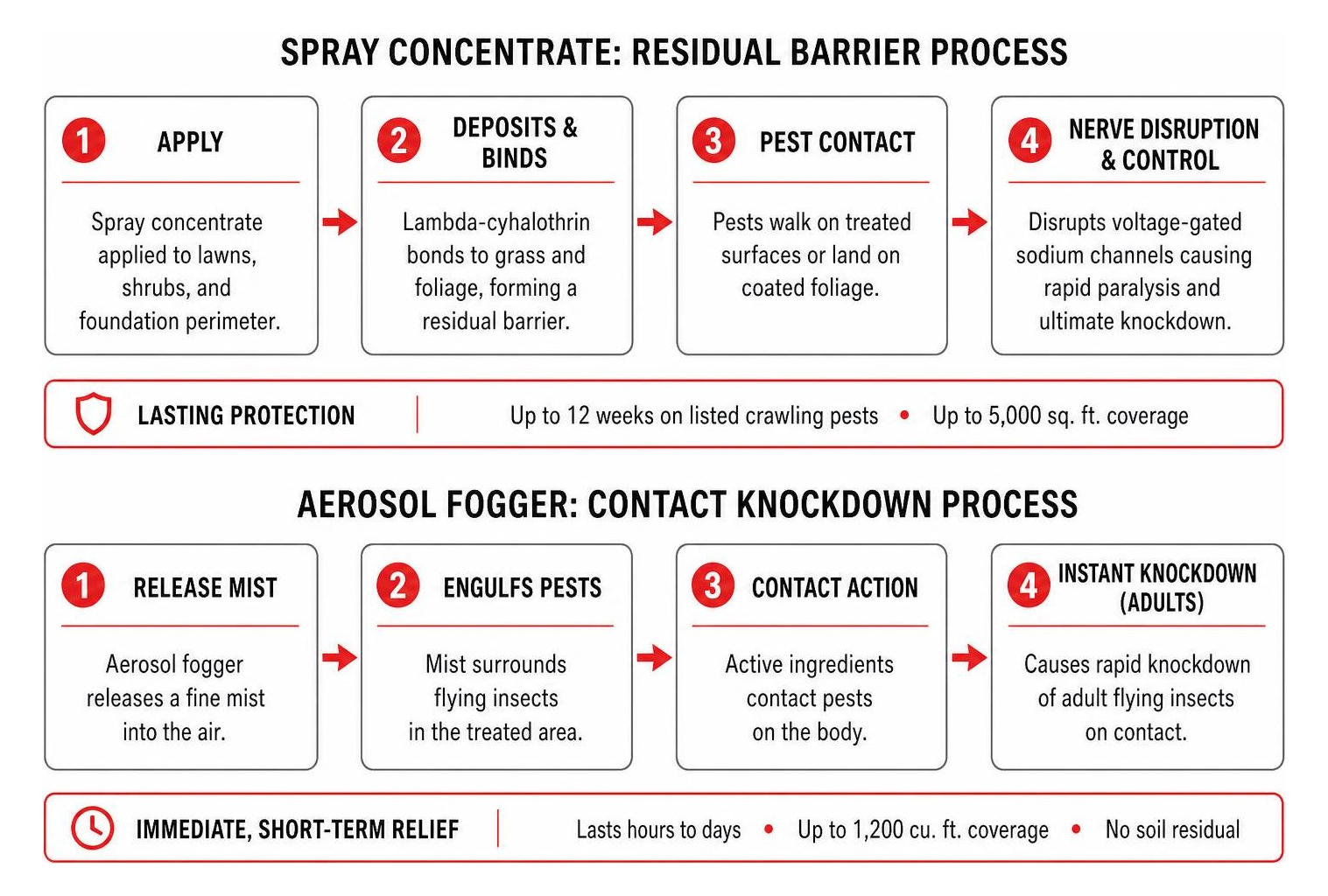
When evaluating any over-the-counter pest control solution, the primary consideration is the chemistry inside the container. The Backyard Bug Control Spray Concentrate (Ready-To-Use) relies on a 0.16% concentration of lambda-cyhalothrin.
Lambda-cyhalothrin is a potent synthetic pyrethroid designed to mimic the natural insecticidal compounds found in chrysanthemum flowers. It operates as a broad-spectrum neurotoxin for cold-blooded arthropods. When targeted pests walk across treated grass or land on coated foliage, the active ingredient disrupts their voltage-gated sodium channels. This causes rapid nerve firing, swift paralysis, and ultimate knockdown.
Because lambda-cyhalothrin is broad-spectrum, it does not discriminate between a biting pest and a beneficial organism. It presents high toxicity to aquatic life, including fish and freshwater invertebrates, and is hazardous to foraging honeybees when sprayed directly onto blooming plants. Understanding these chemical characteristics helps homeowners achieve optimal pest knockdown without disrupting local ecosystems.
| Feature / Specification | Spray Concentrate (Hose-End) | Outdoor Fogger (Aerosol) |
|---|---|---|
| Active Ingredients | 0.16% Lambda-Cyhalothrin | 0.20% Tetramethrin, 0.20% Phenothrin |
| Primary Mechanism | Residual surface barrier | Instant contact knockdown mist |
| Target Treatment Area | Lawns, shrubs, foundation perimeter | Patios, decks, picnic areas, open air |
| Rated Coverage | Up to 5,000 sq. ft. per 32 oz. bottle | Up to 1,200 cu. ft. (8′ x 10′ x 15′) |
| Residual Longevity | Up to 12 weeks (listed crawling pests) | Short-term (hours to days; no soil residual) |
| Water / Hose Required | Yes (standard garden hose) | No (aerosol can ready out of the box) |
Backyard Mosquito and Bug Control Spray vs. Outdoor Fogger
Homeowners frequently ask whether they should buy the liquid concentrate or the aerosol can. The choice depends on whether you need a lasting barrier or immediate relief for an evening gathering.
The 16 oz. Backyard Bug Control Outdoor Fogger is engineered for immediate, localized relief. Powered by 0.20% tetramethrin and 0.20% phenothrin, this aerosol delivers a fine mist designed to clear out adult flying insects instantly. It is ideal for spot-treating around a patio, deck, or outdoor dining table roughly 15 to 30 minutes before guests arrive. However, foggers offer little to no lasting protection once the airborne droplets settle and disperse.
In contrast, the Cutter Backyard Bug Control Spray Concentrate (3 Pack), Kills Mosquitoes, Fleas & Listed Ants, 32 fl Ounce(2 Pack) – Cutter creates a surface barrier on turf and landscape foliage. It bonds with organic matter to eliminate bugs over weeks rather than minutes. If you want structural protection across an entire lawn, the spray concentrate is the proper tool. For localized outdoor events where bugs are currently swarming, the fogger provides quick relief.
Coverage Area and Lawn Size Calculations
A single 32-ounce bottle of the hose-end concentrate is calibrated to cover up to 5,000 square feet of lawn surface. To ensure proper application without running out mid-yard or over-saturating your turf:
- Calculate Your Target Square Footage: Measure the length and width of your treatable turf and landscape beds (e.g., a 50 ft. x 80 ft. back lawn equals 4,000 square feet). Exclude non-target areas like vegetable gardens, driveways, swimming pools, and patios.
- Determine Bottle Requirements: Divide your total square footage by 5,000. If your treatable yard area is 8,500 square feet, you will need two 32-ounce bottles.
- Pace Your Application: The sprayer mechanism dispenses product in tandem with water flow. Walk at a steady, deliberate pace to empty the bottle uniformly across the measured 5,000-square-foot grid.
For the aerosol fogger, coverage is measured volumetrically. One 16-ounce can covers up to 1,200 cubic feet, corresponding to an area roughly 8 feet high, 10 feet wide, and 15 feet long.
Application Guide: Using the Hose-End Sprayer
Proper application ensures you achieve effective coverage while avoiding chemical runoff. If you are comparing DIY costs against professional services, you can read a homeowner’s guide to vetting local mosquito yard treatments to understand how equipment and calibration differ between consumer sprayers and commercial rigs.
How to Apply Backyard Mosquito and Bug Control with the Hose-End Sprayer
The built-in QuickFlip hose-end sprayer eliminates manual chemical mixing, but it requires correct operation:
- Inspect the Hardware: Ensure your garden hose has standard water pressure and that the spray nozzle’s dial is in the “OFF” position before attaching.
- Connect Securely: Thread the sprayer head tightly onto the male end of your garden hose to prevent chemical-laced water from dripping onto your hands.
- Engage Water Flow: Turn on your home’s outdoor water spigot completely.
- Flip the Switch: Extend the hose to the farthest corner of your yard first. Turn the sprayer switch to “ON.” Water and concentrate will mix automatically inside the nozzle chamber at the label-dictated ratio.
- Maintain Overlapping Passes: Walk backward toward your water source, swinging the nozzle in a side-to-side sweeping motion. Overlap each pass by 10% to 15% to eliminate untreated gaps. Spray grass evenly until it is damp, but avoid soaking the ground to the point of pooling or runoff.
- Focus on Resting Zones: Direct the spray under shaded ornamental shrubs, tall turf fringes, and dense groundcovers where adult mosquitoes rest during the heat of the day.
Reapplication Timing and Weather Resilience
The product packaging highlights residual protection lasting up to 12 weeks for specific crawling pests like house crickets, carpenter ants, harvester ants, lady beetles, and earwigs. However, real-world summer conditions in areas like Wake Forest, Apex, and Chapel Hill rarely allow a single application to last three full months against active mosquitoes.
Summer rainstorms, strong UV sunlight, and frequent lawn mowing degrade pyrethroid deposits on turf blades. For consistent mosquito suppression during peak season, reapplication is generally required every 3 to 4 weeks. If an unexpected heavy downpour occurs within 24 hours of application, the residual barrier can wash away, requiring a re-treatment once the turf completely dries.
Target Insects: What It Kills and What It Misses

Cutter Backyard Bug Control Spray Concentrate acts on a variety of surface and subsurface pests. Understanding which insects it controls—and which require different treatments—prevents wasted effort.
- Target Insects Controlled: Mosquitoes, fleas, deer ticks, brown dog ticks, house crickets, earwigs, lady beetles, harvester ants, carpenter ants, chinch bugs, sod webworms, aphids, and lawn moths.
- Pests Requiring Alternative Treatments: Red imported fire ants (mound-building colonies), pharaoh ants, subterranean termites, bed bugs, German cockroaches, and carpenter bees nesting within structural wood.
Efficacy on Mosquitoes, Fleas, and Ticks
For active adult mosquitoes, the spray works as a contact kill during application and leaves a residual barrier on leaves and grass blades. When resting mosquitoes shelter in treated shrubbery during hot daylight hours, exposure to the dry residual controls them.
The formula also targets fleas and ticks in outdoor areas. It helps disrupt the life cycle of deer ticks and dog ticks in shaded transition zones between lawns and wooded tree lines. This minimizes the risk of pests hitchhiking into the home on pets or family members.
Ant Control Limitations and Other Exceptions
While the concentrate label lists various ant species—including carpenter and harvester ants—it is vital to understand how pyrethroids affect social insects. Lambda-cyhalothrin is a fast-acting contact repellent. When foraging ants encounter a treated zone, they die quickly, but the active ingredient does not transfer back to the queen or eliminate deep underground galleries.
Furthermore, the product is not an effective stand-alone eradication tool for aggressive red imported fire ant mounds. Knocking down surface foragers with a hose-end spray can agitate a colony or cause budding, where the queen relocates deeper into the soil. For systemic ant issues, targeted bait formulations remain necessary.
Safety Precautions: Pets, Children, and Environmental Impact

Safety should always guide the use of outdoor pesticides. While lambda-cyhalothrin is widely used, strict adherence to label guidelines protects your family, pets, and non-target wildlife.
- Pet and Child Safety: Keep children and pets off treated lawns, mulch beds, and patio perimeters throughout the application process. Do not allow them back onto the lawn until the spray has completely dried. Depending on humidity, temperature, and sun exposure, drying takes between one and three hours. Once dry, the active ingredient binds securely to organic matter and foliage.
- Pollinator Protection: Lambda-cyhalothrin is toxic to honeybees and native pollinators. Never spray flowering plants, blooming clover, vegetable blossoms, or active pollinator beds. Apply sprays early in the morning or near dusk when pollinator foraging activity is minimal.
- Aquatic Buffer Zones: Pyrethroids are hazardous to fish and aquatic life. Maintain a minimum 10-foot untreated buffer zone around ponds, streams, drainage ditches, and retention basins. Never spray directly onto hard surfaces like driveways, sidewalks, or gutters where rain can wash the chemical into municipal storm drains.
Real Customer Feedback, Ratings, and Performance Analysis
Aggregated real-world consumer data reflects consistent satisfaction balanced by typical DIY limitations. Across major retail platforms:
- The product holds a 4.4 out of 5-star rating from 6,722 reviews on Amazon.
- It holds a 4.4 out of 5-star rating across 1,596 reviews on Walmart, with 73% of buyers awarding a full 5-star rating.
- On the official manufacturer site, it maintains a 4.4 out of 5-star rating, with 23 out of 24 verified users (96%) recommending the product.
- The outdoor fogger twin-pack maintains a 4.7 out of 5-star rating on the manufacturer portal and over 500 reviews via Home Depot.
Positive reviews routinely praise the convenience of the QuickFlip bottle and rapid reduction in mosquito bites during summer gatherings. Conversely, recurring complaints cite defective hose connection plastic threads, strong chemical odors during application, and reduced effectiveness when unexpected rainstorms follow treatment.
Frequently Asked Questions About Backyard Bug Control
Is Backyard Bug Control safe for pets and children once dry?
Yes. Once the liquid spray dries completely on grass, leaves, and soil, people and pets can return to the lawn. Drying allows the active ingredient to bind tightly to surfaces, minimizing dermal transfer. To stay safe, wait 2 to 3 hours on humid days before letting dogs, cats, or children play in treated areas.
Does rain wash away Backyard Bug Control?
Rainfall will degrade the protective barrier if precipitation occurs before the spray dries completely. Once dry, the formula resists light dew and minimal sprinkling. However, consistent or heavy rain accelerates chemical breakdown and washes active residues from leaf surfaces. In wet conditions, reapplication every 2 to 3 weeks is typically needed to maintain insect suppression.
Can Backyard Bug Control be used near vegetable gardens or ponds?
No. The concentrate should never be applied directly to edible crops, fruit-bearing trees, vegetable gardens, or herb patches. It is not labeled for food plants. Additionally, keep a strict buffer away from decorative koi ponds, natural creeks, and storm drains, as pyrethroids are toxic to aquatic ecosystems.
Conclusion
Cutter Backyard Mosquito and Bug Control provides an accessible, budget-conscious starting point for homeowners seeking short-term relief from biting pests. For treating modest residential lawns before a cookout or suppressing general lawn surface feeders, its hose-end system delivers measurable knockdown.
However, broad-spectrum DIY sprays cannot address standing water breeding sites, deep-seated ant colonies, or structural pest pressures. When dense foliage, high humidity, and recurring pest cycles overwhelm off-the-shelf treatments, consider our targeted mosquito control services for comprehensive property evaluation, eco-friendly barrier applications, and dedicated insect growth regulators tailored to your landscape.
Capital Pest is proud to be a family-owned and operated pest control company serving Raleigh, NC and its surrounding area (Chapel Hill, Wake Forest, Clayton, Pinehurst, Pittsboro, Fuquay-Varina, etc). Contact us for our pest control services today!