A Homeowner Field Guide to Identifying Triangle Area Cockroaches
Cockroach Identification in Raleigh: Start With Size and Markings
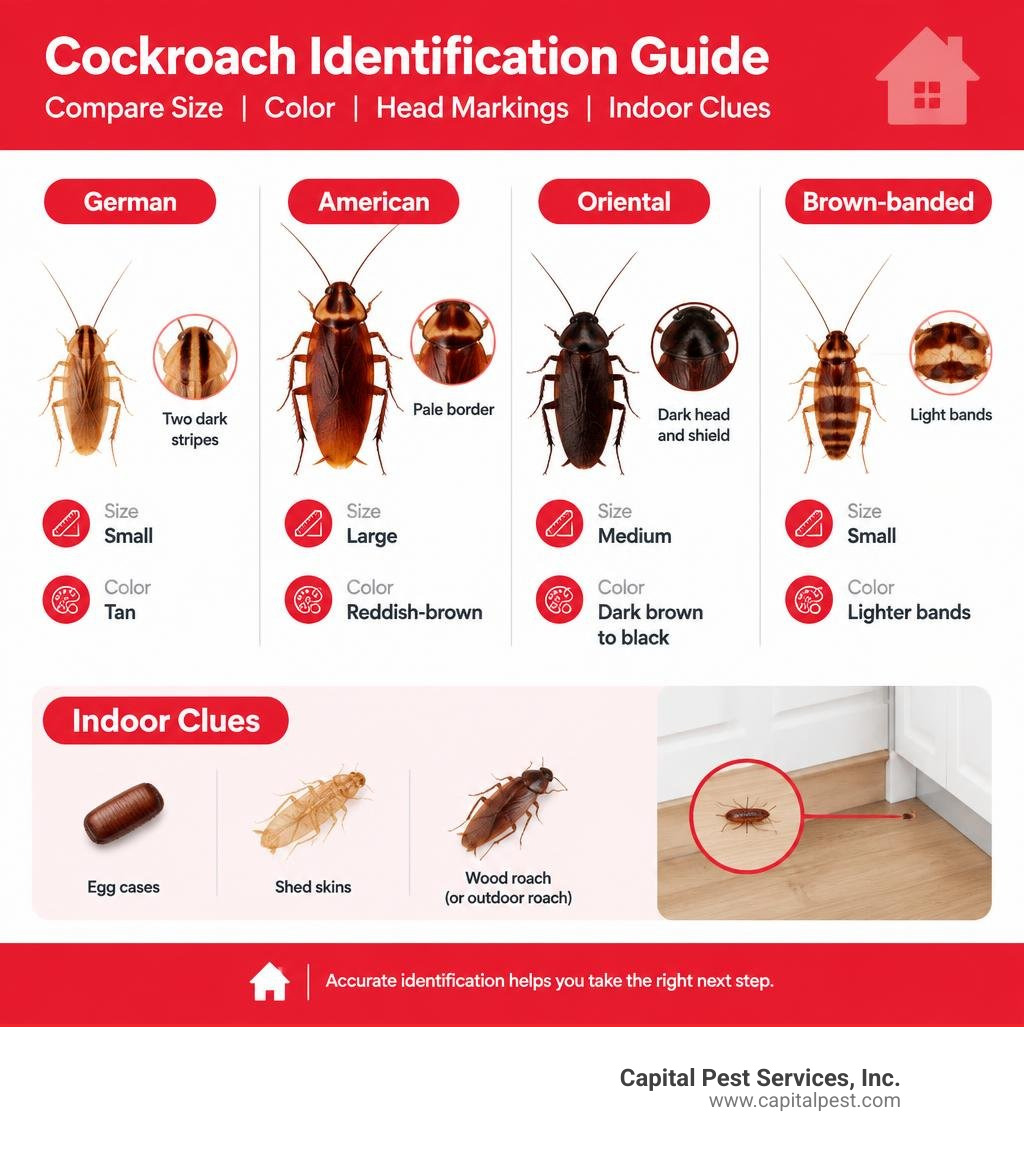
For cockroach identification in Raleigh, first check the roach’s size, color, and markings on the shield behind its head:
- German: Small and tan, with two dark stripes behind the head.
- American: Large and reddish-brown, with a pale border behind the head.
- Oriental: Dark brown to black, with short wings.
- Brown-banded: Small, with lighter bands across its body and wings.
A large, dark smoky-brown roach or a wood roach may have wandered in from outdoors. Finding small roaches, egg cases, or shed skins indoors calls for a closer look. This guide will help you compare those clues before deciding what to do next.
I’m Mitch Taylor, president of Capital Pest Services, Inc. My more than 17 years of pest-control work in the Triangle inform the cockroach identification Raleigh homeowners will find in this guide.
Key cockroach identification Raleigh vocabulary:
- american cockroach control nc
- cockroach control
The Importance of Accurate Cockroach Identification in Raleigh Homes
Finding an insect scuttling across your kitchen baseboard or crawlspace access door can trigger immediate frustration. However, rushing to grab a generic bug spray without knowing what you are dealing with rarely solves the problem. Accurate identification is the foundation of effective management because different species require vastly different approaches.
In North Carolina homes, indoor biodiversity is surprisingly high. Landmark urban entomology research demonstrated this when scientists sampled 50 homes across the Raleigh Piedmont and collected over 10,000 specimens representing hundreds of unique arthropod species. This comprehensive research on indoor insect biodiversity proves that our homes interact continuously with the surrounding environment.
Beyond being an unsettling nuisance, structural pests pose genuine health hazards. Indoor roach infestations are notorious for spreading bacteria like Salmonella and E. coli across food preparation surfaces. Furthermore, cast skins, saliva, and droppings break down into microscopic airborne particles that trigger chronic allergies and severe asthma attacks, particularly in young children. Understanding the specific health risks associated with cockroach allergens underscores why confirming the exact pest species in your home is vital for your family’s safety.
Major Household Species: German, American, Oriental, and Brown-Banded
To establish an effective treatment plan, you must determine whether the intruder is a dedicated domestic pest or a temporary outdoor invader. Four primary species invade homes and commercial buildings across Raleigh, Durham, Cary, and Wake Forest.
| Cockroach Species | Adult Size | Body Color | Pronotum (Head Shield) Markings | Preferred Indoor Habitat |
|---|---|---|---|---|
| German Cockroach (Blattella germanica) | 0.5 to 0.6 inches | Light brown to tan | Two distinct, dark parallel longitudinal stripes | Warm, humid kitchens, pantries, and bathrooms near plumbing |
| American Cockroach (Periplaneta americana) | 1.5 to 2.0+ inches | Reddish-brown | Light yellowish or pale band around the outer edge | Basements, crawlspaces, boiler rooms, sewer lines, and floor drains |
| Oriental Cockroach (Blatta orientalis) | 1.0 to 1.25 inches | Dark brown to glossy black | Solid dark color with no distinctive lighter markings | Cool, damp environments such as dark basements, sumps, and utility voids |
| Brown-Banded Cockroach (Supella longipalpa) | 0.5 inches | Light brown | Pale golden bands across the wings and abdomen | Warm, dry, high locations such as upper kitchen cabinets, closet ceilings, and electronics |
The German cockroach is widely considered the most problematic indoor insect pest worldwide. Unlike other species that survive comfortably outdoors, German roaches rely almost entirely on human structures for warmth and sustenance. Because they reproduce rapidly, professional cockroach control should begin the moment you confirm their diagnostic twin stripes.
Distinguishing Invasive Pests from Outdoor Wood Cockroaches
Not every cockroach you spot indoors signals a full-scale structural infestation. In the Triangle area, peri-domestic roaches and native outdoor species often stumble into living spaces by accident.
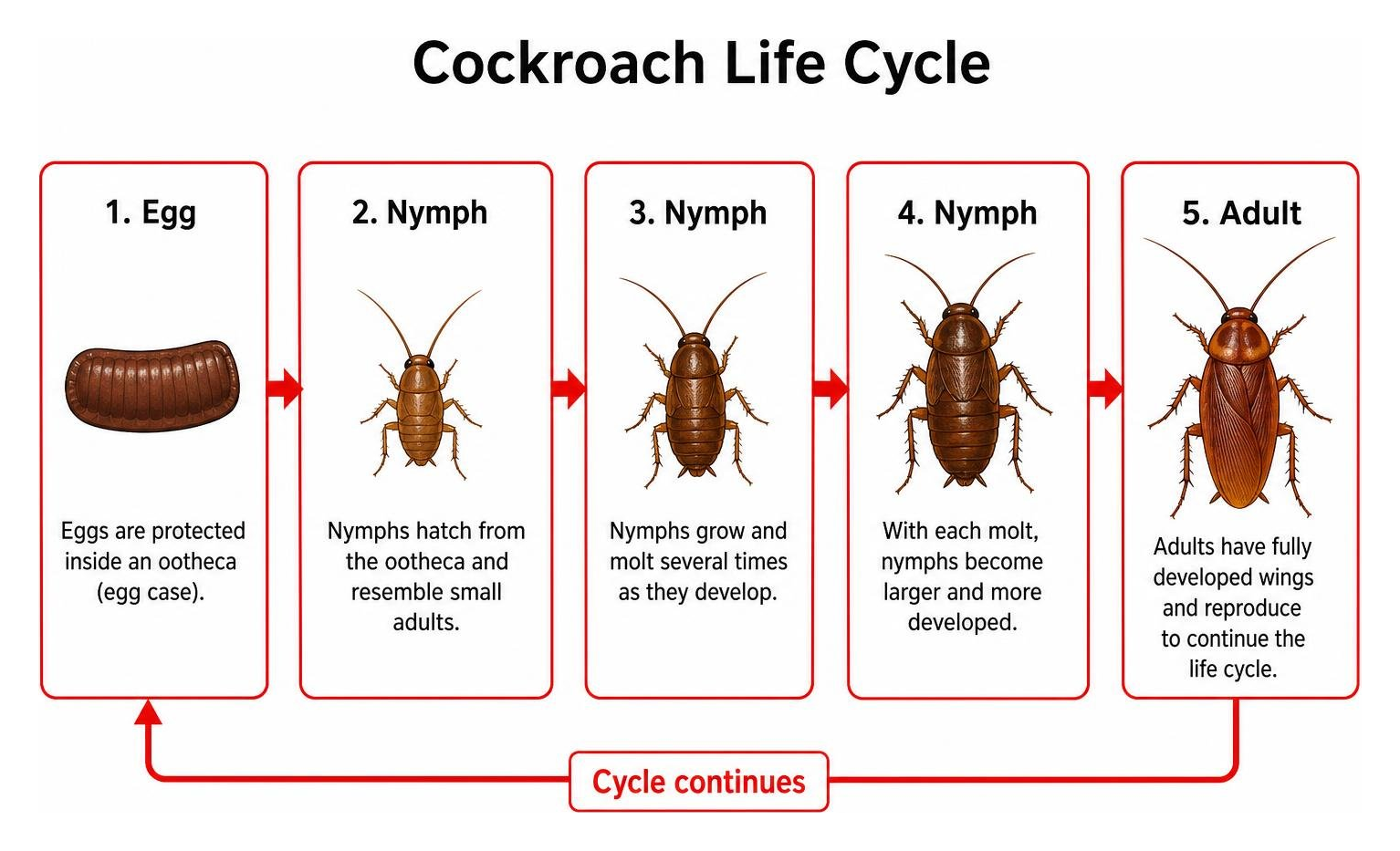
The smoky-brown cockroach (Periplaneta fuliginosa) is the most prevalent outdoor cockroach across the Southeast. Adults grow to roughly 1.5 inches long and exhibit a deep, uniform mahogany-to-black color without the pale edge seen on American roaches. They inhabit mulch beds, tree holes, clogged gutters, and roof eaves. Because they are strong flyers attracted to outdoor porch lights, they frequently wander into attics, upstairs bedrooms, and living rooms during warm summer evenings.
Similarly, native wood roaches (Parcoblatta species) live naturally in wooded landscapes, tucked beneath decaying tree bark and fallen logs. Male wood roaches possess fully developed wings and fly toward exterior lighting, occasionally finding gaps around doors or window screens. Unlike domestic German roaches, wood roaches cannot survive or reproduce in the dry indoor air of modern homes. Utilizing targeted strategies for combating American and smoky-brown roaches around your perimeter prevents these accidental wanderers from crossing the threshold.
Recognizing Infestation Evidence and Life Stages Across Raleigh Properties
Spotting a single roach during daytime hours often indicates a larger population hidden within wall voids and behind cabinetry. Because roaches are nocturnal, identifying physical evidence left behind is crucial for assessing how established the colony is.
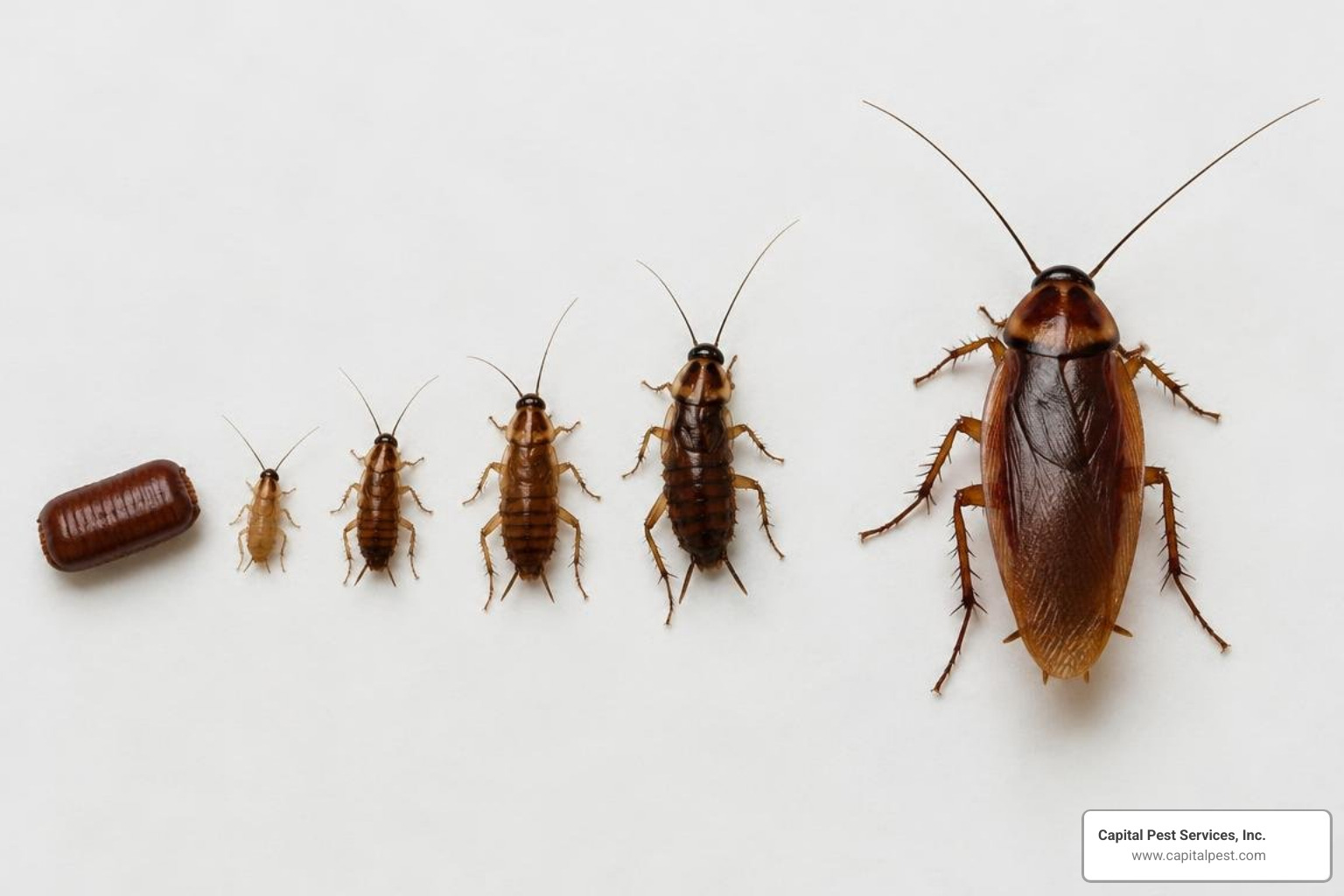
Understanding the cockroach life cycle aids in determining whether a population is breeding indoors:
- Egg Stage (Ootheca): Females produce hardened, purse-shaped capsules called oothecae that protect multiple embryos from physical damage and chemical treatments.
- Nymph Stage: Wingless juveniles emerge from the capsule. As they grow, nymphs molt through multiple developmental phases (instars), shedding their outer cuticle each time.
- Adult Stage: The final molt produces fully formed, sexually mature adults equipped with fully developed wings and reproductive capabilities.
When performing residential inspections in Apex, Holly Springs, and Chapel Hill, discovering small, early-instar nymphs alongside adults indicates an active, breeding domestic population that requires a structured step-by-step cockroach elimination guide.
Reading the Physical Clues: Oothecae, Frass, and Shed Skins
When live insects remain hidden, physical clues provide unmistakable proof of species and nesting density:
- Egg Capsules (Oothecae): A German cockroach ootheca is slender, light brown, about 0.3 inches long, and contains 30 to 40 eggs; females carry it until right before hatching. In contrast, American and smoky-brown capsules are dark reddish-black, broader, and deposited in protected corners or crawlspaces.
- Frass (Droppings): Small roach droppings resemble coarse black pepper or coffee grounds, frequently accumulating in cabinet hinges, drawer glides, and baseboard cracks. Larger species produce cylindrical, blunt-ended pellets that feature distinct longitudinal ridges.
- Shed Skins (Exuviae): As nymphs develop, they cast off translucent amber exoskeletons near harborage sites.
- Pheromone Odors: Established infestations emit an oily, musty odor caused by aggregation pheromones embedded in fecal smear marks.
For broader diagnostic comparisons, homeowners can consult the Cornell IPM cockroach identification guide to cross-reference common household signs.
Using a Diagnostic Key for Cockroach Identification in Raleigh
When you discover an unknown insect, using a systematic physical evaluation simplifies the identification process:
- Step 1: Inspect Head Visibility: Look down at the insect from directly above. A true cockroach has a flattened pronotum (a shield-like plate) that extends forward, hiding its downward-facing head from view.
- Step 2: Examine Leg and Antenna Morphology: Check for long, slender, spiny running legs adapted for rapid movement, paired with thin, whip-like antennae that match or exceed the length of the body.
- Step 3: Evaluate Pronotum Patterns: If the shield is pale tan with two dark, parallel vertical bars, you are looking at a domestic German roach. If it is large, reddish-brown, and encircled by a yellow halo, it is an American roach.
- Step 4: Assess Color Uniformity: A solid dark mahogany shell with strong flight wings indicates a smoky-brown roach, whereas an almost wingless, pitch-black body points to an Oriental cockroach.
Lookalikes and Structural Misidentifications
Insects found around crawlspaces, garages, and foundations are frequently misidentified. Homeowners often mistake harmless beetles, outdoor waterbugs, or destructive wood-destroying insects for common roaches. Utilizing comprehensive residential pest control ensures accurate categorization before treatments begin.
Winged Termite vs. Cockroach Identification in Raleigh
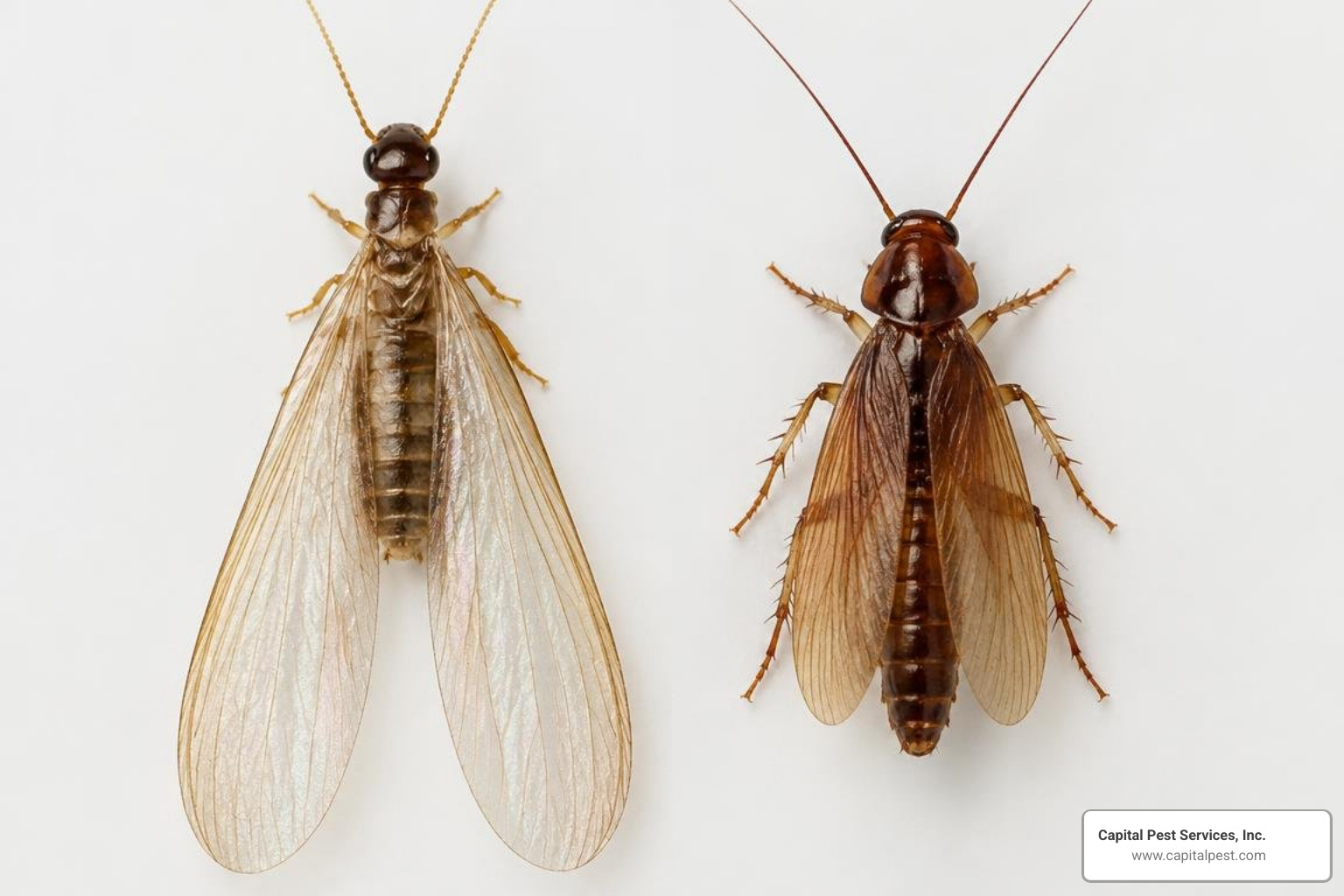
During spring and summer swarming seasons across the Triangle, winged reproductive termites (alates) and small winged cockroaches are frequently confused. Distinguishing between them is essential, as termites directly compromise structural wooden framing.
- Waist Shape: Termites have a broad, uniform waist with no constriction between the thorax and abdomen. Cockroaches have a distinct, flattened oval body with a clear separation behind the head shield.
- Antennae Form: Termite antennae look like tiny strings of straight beads. Cockroaches feature exceptionally long, flexible, whip-like antennae.
- Wing Structure: Swarming termites possess four delicate wings of equal length and shape that extend far past their bodies and drop off easily. Winged adult cockroaches have tough, leathery forewings folded flat over their backs, protecting functional hindwings underneath.
Frequently Asked Questions About Cockroach Identification in Raleigh
What is the most common cockroach found inside Raleigh kitchens?
The German cockroach (Blattella germanica) is the most frequent culprit in residential kitchens. Their small size allows them to hide inside appliance motor housings, cabinet hinges, and sink plumbing voids. Because females produce egg cases containing dozens of nymphs every few weeks, populations expand quickly when food crumbs and moisture are present.
Why are smoky-brown and wood roaches suddenly appearing in my living room?
Smoky-brown and native wood roaches live in natural outdoor harborages like pine straw, mulch beds, oak canopies, and firewood stacks. Heavy rainfall, summer heat waves, or seasonal temperature drops drive them toward structural perimeter gaps. Additionally, these species fly toward bright exterior security lights and slip underneath door thresholds or attic vents.
How do cockroach droppings differ from rodent or insect droppings?
German roach droppings resemble fine black pepper flakes or dark coffee grounds. Droppings from large American or smoky-brown roaches are roughly the size of a grain of rice with blunt ends and distinct lengthwise ridges along their sides. In contrast, mouse droppings have smooth, pointed ends and contain no structural ridges.
Professional Cockroach Management in the Triangle
Accurate species identification dictates whether your home requires interior targeted baiting, crawlspace moisture control, or exterior perimeter exclusion barriers. At Capital Pest Services, Inc., our locally owned, NPA-accredited team uses advanced integrated pest management protocols designed specifically for North Carolina homes. Whether you reside in Raleigh, Durham, Garner, Morrisville, or Clayton, you can schedule professional Raleigh cockroach control with our team to protect your property and ensure long-term peace of mind.
Capital Pest is proud to be a family-owned and operated pest control company serving Raleigh, NC and its surrounding area (Chapel Hill, Wake Forest, Clayton, Pinehurst, Pittsboro, Fuquay-Varina, etc). Contact us for our pest control services today!